Home›Blog›Advanced eSIM guides

Advanced eSIM guides

Regional vs Global eSIM Plans

Buy too small a footprint and you're disconnected at the border. Buy too big and you're paying for 100 countries you'll never visit. The choice between single-country, regional and global eSIM plans is the highest-leverage decision in travel connectivity — and it's simpler than the marketing makes it look. Here's how each plan type actually works under the hood, the decision framework for any itinerary, and how experienced travelers mix plans across trips.

Chapter 1

The three footprints, defined

Single-country plans cover one country on that country's partner networks. They're the simplest product: one destination, one set of networks, usually the best per-gigabyte value for a stay in one place.

Regional plans cover a defined region — Europe, Asia-Pacific, the Americas, the Middle East — typically spanning dozens of countries. One profile, one allowance, valid across every listed country. Cross a border and the phone re-registers on the next country's partner networks automatically.

Global plans cover 100+ countries across regions. One profile for the genuinely multi-region itinerary — the round-the-world trip, the consultant's chaotic quarter, the nomad's transition months.

The trade-off is straightforward: the narrower the footprint, the better the per-gigabyte value; the wider the footprint, the less you think about borders. Everything below is about finding your point on that curve.
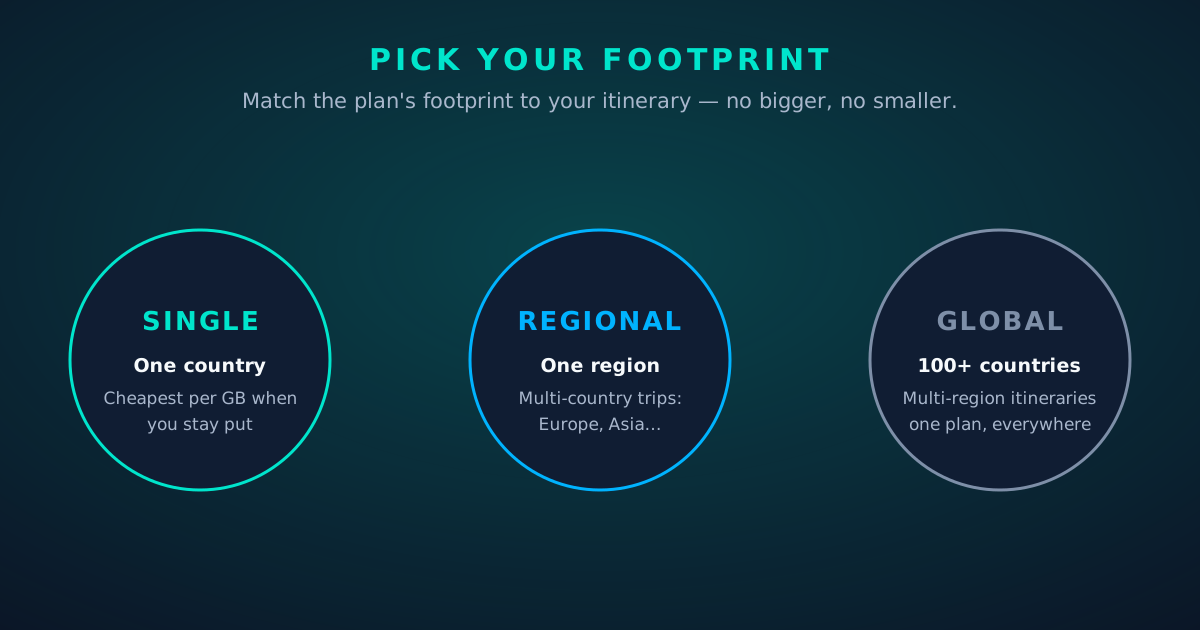
Diagram: single-country, regional and global eSIM coverage footprints
Chapter 2

How regional plans actually work

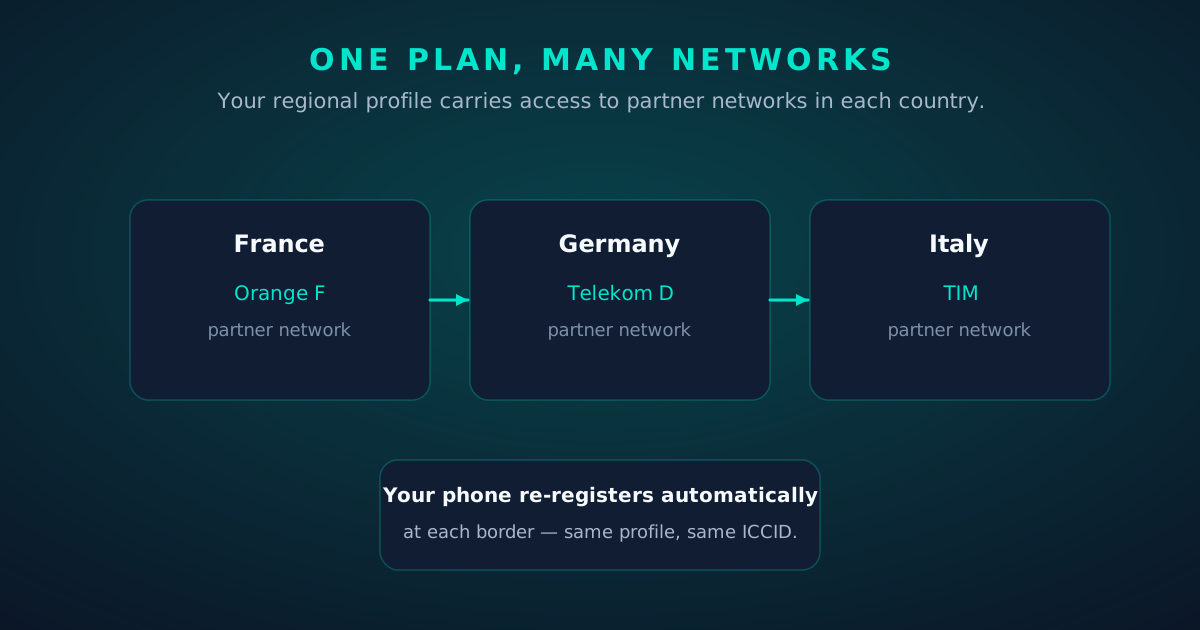
A regional plan isn't one network — it's a roaming agreement bundle. Your provider negotiates wholesale access with partner networks in each covered country, and your single profile carries the credentials to use all of them.

When you cross a border, the phone detects the new country, drops the old registration and attaches to a partner network in the new one — same profile, same ICCID, same data balance. Well-built regional plans steer you to preferred partners per country; occasionally the steering picks a weak partner, and manually selecting another listed network fixes it.

Two things to verify before buying regional:
  • The country list, not the region name. "Europe" might mean 39 countries or 31 — check that your countries are listed, including any microstate or island detours.
  • Whether data is pooled or per-country. Most regional plans pool the allowance across the region (10 GB usable anywhere listed). A few allocate per country — know which you're buying.
Diagram: a regional eSIM profile re-registering on partner networks at each border
Chapter 3

How global plans actually work

Global plans are regional plans scaled up: the same roaming-bundle architecture across 100+ countries and multiple regions. The engineering is identical; the economics differ.

  • You're paying for optionality. The per-gigabyte rate reflects wholesale costs averaged across expensive and cheap markets. If you visit three countries, you subsidize the other 97.
  • Fair-use policies bite harder. Global plans more often carry fair-use clauses — full speed up to a threshold, then throttled — because the provider can't predict your cost to them. Read the terms.
  • Network quality varies more. With 100+ countries, partner quality is uneven by definition. In major destinations it's excellent; in obscure ones it may be a single partner. Set expectations accordingly.

Global plans shine on unpredictable itineraries: the trip where you don't know which countries you'll end up in, or the month hopping regions. If your itinerary is known, regional plans almost always deliver better value.

Chapter 4

The coverage math: when each wins

Run this decision tree for any trip:

  • One country, 4+ days → single-country. Best value, simplest product. No contest.
  • 2–5 countries in one region → regional. One install, pooled data, no per-border admin. The per-GB premium over single-country plans is small; the convenience is large.
  • 6+ countries or 2+ regions → compare. Price a regional per region-hunk versus one global. Two regionals often beat one global on value; one global wins on simplicity.
  • Unknown itinerary → global. When you can't plan, buy optionality.
  • One country + side trips → single-country + regional backup. Buy the cheap single-country for the base, keep a small regional profile for the side trips. Dual-line phones run both.

The common mistake is buying global "just in case" for a two-country trip — paying the optionality premium for options you never exercise.
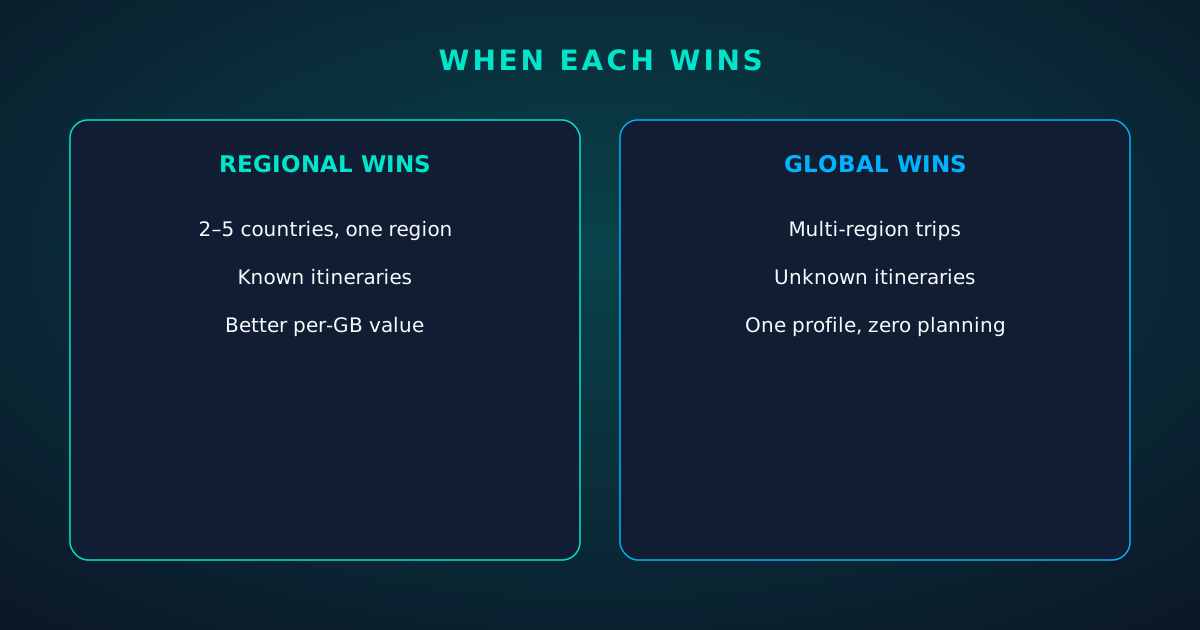
Split panel: when regional plans win versus when global plans win
Chapter 5

Validity strategies for multi-trip use

Plans have two clocks — data and validity (see our top-up guide). Multi-trip travelers can exploit the validity clock:
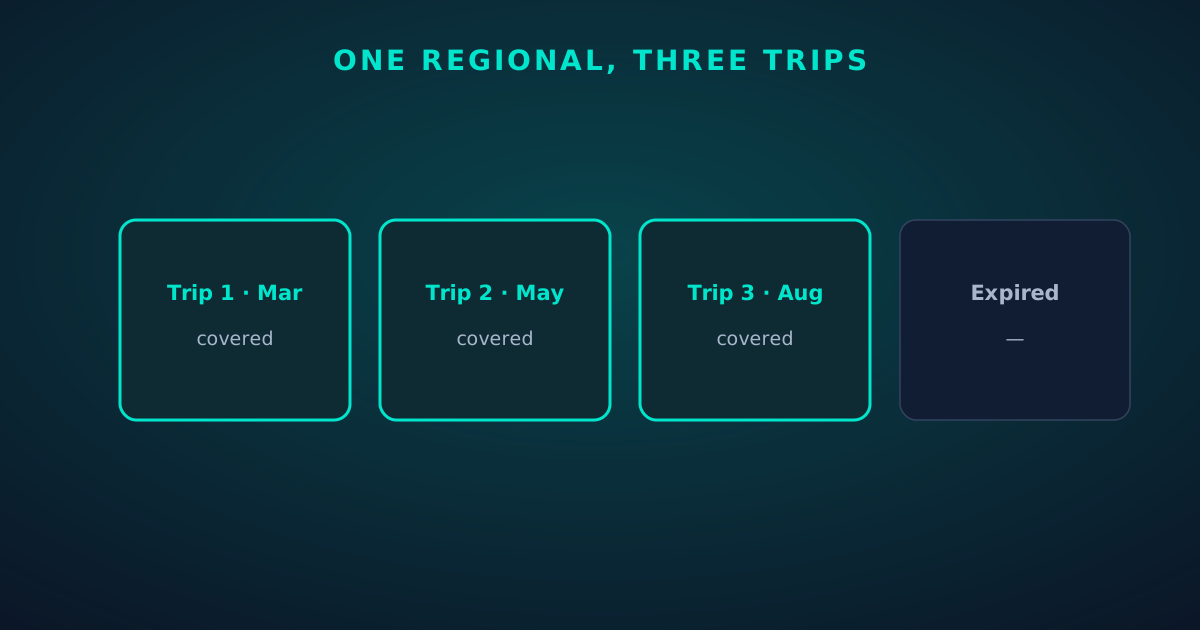
  • Long-validity regionals as a standing profile. A regional plan with 90–180 day validity can cover several short trips to the same region across a season. Install once, top up as needed.
  • Don't strand data. A 20 GB plan for a 4-day trip wastes most of the allowance when validity expires. Size to the trip, not to optimism.
  • Stagger, don't stack. If trip two starts after trip one's plan expires, buy fresh — don't buy trip two's plan early and burn its validity waiting.
  • Top-up aware. If your provider's top-ups extend validity, a long-validity regional plus periodic top-ups becomes a semi-permanent travel line. If they don't, plan around hard expiry.
Calendar: one long-validity regional plan covering three trips in a season
Chapter 6

Mixing plans across a complex itinerary

Complex itineraries deserve composite solutions. Examples from real trip shapes:

  • Two weeks Japan + three days Seoul: single-country Japan (the bulk) + a small Asia-regional profile for Korea. Two lines, each optimal for its leg.
  • Euro summer, six countries: one Europe regional, pooled data, done. Don't buy six single-country plans to save a theoretical margin — the admin cost exceeds it.
  • Round-the-world, 8 weeks: global plan as the backbone + single-country plans for the two longest stays where the per-GB math clearly wins.
  • Business travel, unpredictable: standing global profile with long validity, topped up as needed — the "always ready" line.

Your phone's profile wallet makes this painless: install each leg's plan before departure, label them, and switch the data line as the itinerary changes.
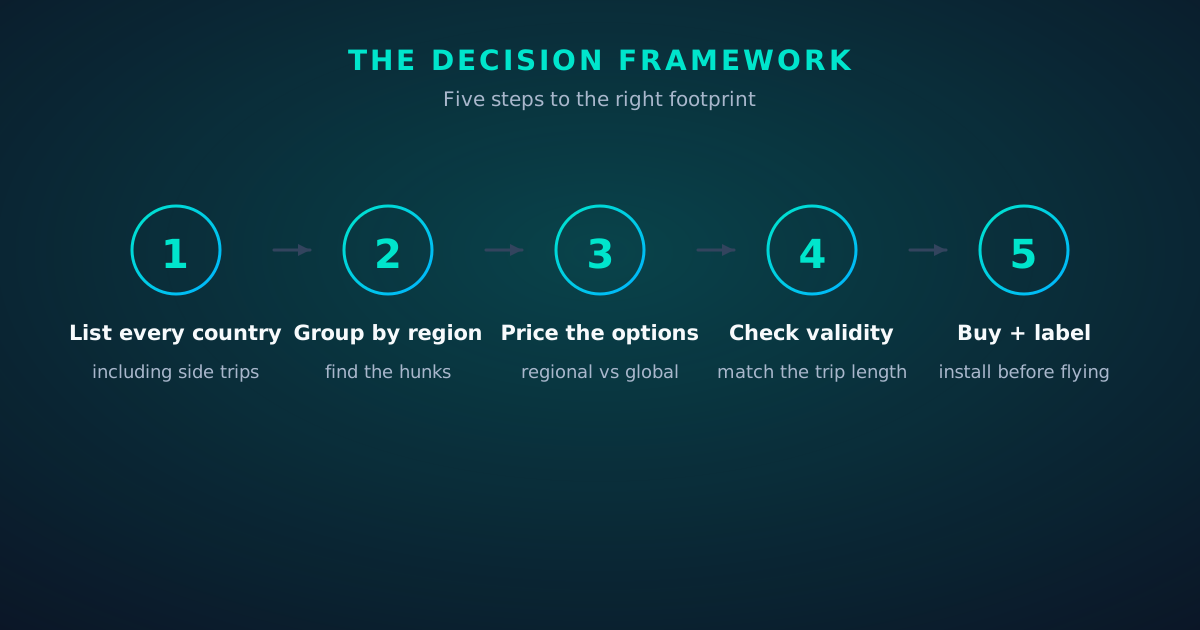
Five-step framework for choosing between single-country, regional and global plans
Chapter 7

Fair use, throttling and the fine print

The terms nobody reads, summarized:

  • Fair-use policy (FUP). Common on "unlimited" and large-bundle plans: full speed to a threshold, reduced speed after. For maps, messaging and email, throttled speeds are usually still usable; for video calls and hotspot work, they're not. Know the threshold before depending on it.
  • Speed caps. Some plans cap at 4G speeds even where 5G exists. Fine for most use; relevant if you're buying for heavy work.
  • Tethering clauses. Hotspot may be allowed, metered separately, or forbidden. Check — "unlimited" plans are the most likely to restrict it.
  • Permanent-roaming clauses. A few plans forbid using the plan predominantly outside one country for months. Nomads on 6-month single-country plans should check this.
  • Activation windows. Some plans must be activated within months of purchase. Don't stockpile plans for next year without checking.
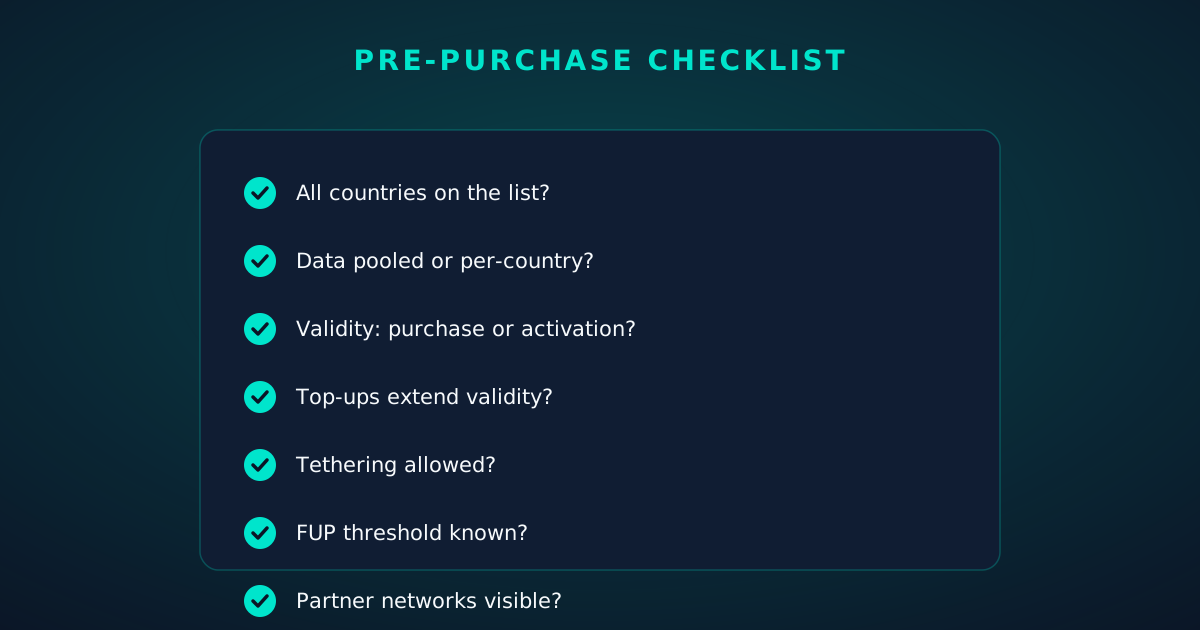
Checklist: seven questions to answer before buying any eSIM plan
Chapter 8

The pre-purchase checklist

Before you buy any plan, answer these:

  • Are all my countries on the coverage list — including side trips and layover countries?
  • Is the allowance pooled across the footprint or allocated per country?
  • When does validity start — purchase or first connection?
  • Do top-ups extend validity, or just add data?
  • Is tethering allowed, and is it metered separately?
  • What's the fair-use threshold and throttled speed, if any?
  • Can I see the partner networks per country?

Seven questions, two minutes, and you'll never buy the wrong footprint again.

FAQ

Questions travelers actually ask.

Should I buy regional or global for a two-country trip?
Regional, if both countries are in the same region — it's cheaper and the coverage is equivalent. Global only earns its premium on multi-region or unpredictable itineraries.
Is a regional plan's data shared across countries?
Usually yes — most regional plans pool the allowance across all covered countries. A minority allocate per country, so verify in the plan terms before you buy.
Can I use a single-country plan in a neighboring country?
No — that's the defining limit of single-country plans. If there's any chance you'll cross the border, buy regional or carry a second profile.
Do global eSIM plans throttle speeds?
Many do, via fair-use policies: full speed to a threshold, then reduced. Read the FUP terms — throttled speeds handle messaging and maps but struggle with video calls.
What's better for a 3-month stay: regional or single-country?
Single-country, almost always — best per-GB value and no footprint you don't need. Keep a small regional or global profile as backup for side trips.
Can I keep one regional plan across multiple trips?
Yes, if the validity window covers them. Long-validity regionals (90–180 days) work well as a standing profile for repeated trips to the same region, topped up as needed.
Keep going

Your next read.

📶

eSIM Data Top-Ups, Explained

Validity clocks and refill timing.

Read next
📱

The Dual-eSIM Travel Playbook

Run multiple footprints as multiple lines.

Read next
🛫

esimgomobile eSIM plans

The right footprint for your route. Live now.

Read next

Up close

From the article to your phone.

A visual walkthrough built for this page — mockups of the exact experience plus photography from the field.


My eSIM
91%5 GB left
Days left12
Top up+10 GB
Data dashboard on Regional vs Global eSIM Plans (2026): 91% remaining, days left, top-up one tap away.
  1. 1The Tele Agent answers in plain language — no telecom jargon.
  2. 2Every answer is specific to your trip, not a generic FAQ.
Install
1 Scan2 Add3 Go
The Regional vs Global eSIM Plans (2026) install: QR in three steps — scan, add, go, about two minutes.
  1. 1The plan card shows exactly what you're buying — data, days, destination.
  2. 2One tap starts the two-minute QR install.
esimgomobile.com
Plans for Regional vs Global eSIM Plans
Atlas 5GB5 GB · 30 days
Atlas 20GB20 GB · 30 days
Atlas 50GB50 GB · 60 days
Compare plans
Plan picker on Regional vs Global eSIM Plans (2026): 5GB, 20GB, 50GB and Unlimited — pick by trip, not fine print.
  1. 1Checkout shows the full price before you pay. Nothing hidden.
  2. 2Amazon Pay handles payment securely; taxes are calculated for you.
Why travelers pick it
  • 5G where available
  • Keep WhatsApp number
  • One-tap top-up
Why travelers pick Regional vs Global eSIM Plans (2026): 5G where available, Keep WhatsApp number, One-tap top-up.
  1. 1The roaming math, made visible: one price versus per-day carrier fees.
  2. 2This is the comparison most travelers never see until the bill.
Regional vs Global eSIM Plans · 5G
Signal widget on Regional vs Global eSIM Plans (2026): network generation and place, always visible.
  1. 1Signal widget: network generation and destination, always visible.
  2. 2Five bars, zero ambiguity about what you're connected to.
esimgomobile.com
Checkout
Atlas 5GB — Regional vs Global eSIM Planstotal
Taxescalculated
Pay securely
256-bit encrypted · Amazon Pay
Secure checkout on Regional vs Global eSIM Plans (2026): Atlas 5GB, full price up front, no fine print.
  1. 1Three plans side by side so the trade-off is obvious.
  2. 2Pick by trip length, not by decoding fine print.
Atlas 50GB
50 GB · 60 days
Regional vs Global eSIM Plans
Atlas 50GB — 50 GB · 60 days, prepaid and ready on Regional vs Global eSIM Plans (2026).
  1. 1Usage ring compresses the whole plan into one glanceable number.
  2. 2Percent remaining is the only metric most travelers check.
Support
How does Regional vs Global eSIM Plans (2026) work?
Enter your trip details and get an instant answer — no account needed.
Support snippet — Regional vs Global eSIM Plans (2026): what it does, in one honest answer.
  1. 1A real traveler quote, tied to the destination it mentions.
  2. 2Reviews reference actual trips, not generic praise.
eSIM plan
Atlas 20GB20 GB · 30 days
Regional vs Global eSIM Plans
Install eSIM
Atlas 20GB on Regional vs Global eSIM Plans (2026) — 20 GB · 30 days, prepaid with the full price shown before you pay.
  1. 1Live usage ring: see remaining data at a glance, no mental math.
  2. 2Top-up button sits right where you need it when data runs low.
195
destinations live
launch fact
Launch fact behind Regional vs Global eSIM Plans (2026): 195 destinations live — a fixed figure, not live telemetry.
  1. 1The roaming math, made visible: one price versus per-day carrier fees.
  2. 2This is the comparison most travelers never see until the bill.
esimgomobile.com
people working as call center agents
Regional vs Global eSIM Plans (2026)
Travel guides · 8 min read
From the blog: “Regional vs Global eSIM Plans (2026)” — travel guides in about eight minutes.
  1. 1Checkout shows the full price before you pay. Nothing hidden.
  2. 2Amazon Pay handles payment securely; taxes are calculated for you.
Regional vs Global eSIM Plans · coverage
5 carriers · automatic selection
Coverage map on Regional vs Global eSIM Plans (2026): partner networks pinned, selection automatic.
  1. 1Coverage pins show where partner networks are live.
  2. 2The map answers the only question that matters: will it work there?
32%
data left
Usage ring on Regional vs Global eSIM Plans (2026) — 32% of data left: the number travelers check most.
  1. 1The plan chip: name, allowance and destination in one line.
  2. 2Everything you need to confirm you're on the right plan.
eSIM installedYour Regional vs Global eSIM Plans plan is ready.
Push · just now
Push notification on Regional vs Global eSIM Plans (2026): eSIM installed, plan ready to activate.
  1. 1Coverage status at a glance: data live, number available, 5G ready.
  2. 2Green means go — no guessing about what's supported.
Virtual number
+1 205 024 1234
Routes toRegional vs Global eSIM Plans
SMS + voiceEnabled
Your second line on Regional vs Global eSIM Plans (2026): +1 205 024 1234 — real number, SMS and voice enabled.
  1. 1Coverage status at a glance: data live, number available, 5G ready.
  2. 2Green means go — no guessing about what's supported.
silhouette of a woman with a backpack standing at an airport terminal
Ready for your trip?
Get your eSIM
“Ready for your trip?” — the banner on Regional vs Global eSIM Plans (2026): two minutes from curious to connected.
  1. 1Mockups illustrate the product flow — captions describe what's real.
  2. 2Figures labeled as examples show sample data, never live telemetry.
Language
EnglishEspañol日本語
Language picker on Regional vs Global eSIM Plans (2026) — English, Español, 日本語: the app speaks six languages.
  1. 1The plan chip: name, allowance and destination in one line.
  2. 2Everything you need to confirm you're on the right plan.
Network
5G
Regional vs Global eSIM Plans connected
Network widget for Regional vs Global eSIM Plans (2026): 5G, full bars — zero ambiguity about the connection.
  1. 1Illustrative speed readout: sample carrier, city and latency figures.
  2. 2The meter demonstrates the readout — figures are examples, not live measurements.
Coverage
195
destinations live
Regional vs Global eSIM Plans5G ready
Check coverage
Coverage at a glance for Regional vs Global eSIM Plans (2026): 195 destinations live, fastest local partner selected on its own.
  1. 1Live usage ring: see remaining data at a glance, no mental math.
  2. 2Top-up button sits right where you need it when data runs low.
white concrete buildings near the sea
Your travel number is waiting.
Get your eSIM
Live now · no waitlist
“Your travel number is waiting.” — the CTA card on Regional vs Global eSIM Plans (2026): plans live now, no waitlist.
  1. 1Coverage status at a glance: data live, number available, 5G ready.
  2. 2Green means go — no guessing about what's supported.
silhouette of a woman with a backpack standing at an airport terminal — Rainy-day backup plan: indoor attractions researched from the hostel bunk.
Rainy-day backup plan: indoor attractions researched from the hostel bunk.
woman hiking on hill — Travelers stay online from the moment they land — no SIM queues, no roaming shock.
Travelers stay online from the moment they land — no SIM queues, no roaming shock.
white and black sailing ship print ceramic plate — Platform to platform: tickets, timetables and taxis in one hand.
Platform to platform: tickets, timetables and taxis in one hand.
woman having a video call — Old town, new tricks: translation apps working in real time.
Old town, new tricks: translation apps working in real time.
Bernd Feurich — The connected trip: maps, messages and translation, all on one eSIM.
The connected trip: maps, messages and translation, all on one eSIM.
bustling night market street in tokyo — Lost in the medina, found by GPS: the blue dot never lies.
Lost in the medina, found by GPS: the blue dot never lies.
crop man working on laptop at table with domestic cat — Duty-free browsing: price-checked against home before buying.
Duty-free browsing: price-checked against home before buying.
man in a mountain valley covered with snow — Downtown, connected: the eSIM finds the fastest local network on its own.
Downtown, connected: the eSIM finds the fastest local network on its own.
eiffel tower with parisian architecture — From departure lounge to arrival hall, the data never drops.
From departure lounge to arrival hall, the data never drops.
view of a crowded shibuya district at night tokyo japan — The long layover: streaming, working and messaging, all covered.
The long layover: streaming, working and messaging, all covered.
Jess Loiterton — City lights after dark — the eSIM doesn't care what time it is.
City lights after dark — the eSIM doesn't care what time it is.
Man using a smartphone on a train journey through scenic landscape. — The departure board flips: gate found, lounge located, all on the eSIM.
The departure board flips: gate found, lounge located, all on the eSIM.
women at the beach — The last night: photo album backed up, memories safe before wheels-up.
The last night: photo album backed up, memories safe before wheels-up.
white and black electronic device — Coast roads and country lanes — the map keeps up wherever you roam.
Coast roads and country lanes — the map keeps up wherever you roam.
woman in black long sleeve shirt using headphones — Street-food stalls and mobile pay: dinner ordered without a word of the language.
Street-food stalls and mobile pay: dinner ordered without a word of the language.
wing of aircraft flying over clouds at sundown — Market mornings: look up the dish, translate the menu, pay by phone.
Market mornings: look up the dish, translate the menu, pay by phone.
iconic eiffel tower in summer foliage — The food tour: every recommendation looked up on the spot.
The food tour: every recommendation looked up on the spot.
Anurag Jamwal — The window seat office: emails sent somewhere over the ocean.
The window seat office: emails sent somewhere over the ocean.
manhattan cityscape with skyscrapers — The rental desk handshake: confirmation email open, license photo ready.
The rental desk handshake: confirmation email open, license photo ready.
smoothie on top of white laptop computer — The red-eye recovery: hotel early-check-in arranged mid-flight.
The red-eye recovery: hotel early-check-in arranged mid-flight.

Explainer

Key takeaways

  • The core idea: Regional vs Global eSIM Plans (2026) matters because connectivity shapes the whole trip, not just the phone bill.
  • Data-first eSIMs keep your number and your apps; the only thing that changes is the price.
  • When something goes wrong abroad, the fix is almost always: toggle airplane mode, check the eSIM line is enabled, then ask the Tele Agent.
  • Setup beats improvisation — every tip in this article works best arranged before departure.
  • Match the plan to the trip length and your heaviest single use-case, then stop thinking about it.

Explainer

Putting it into practice

Install the eSIM now — it costs nothing to have it sitting on your phone waiting. Activation happens when you say so.

Then run through the travel tips checklist above. Ten minutes of preparation saves hours of airport problem-solving.

Reading about Regional vs Global eSIM Plans (2026) is step zero. Step one is a two-minute action: check your phone is unlocked and eSIM-capable, then pick a plan sized to your next trip.

Go deeper

The tools index turns article advice into instant answers — coverage checks, plan pickers and compatibility checks that take seconds.

And the Tele Agent will walk through any of this conversationally if you'd rather talk than read.

Explainer

Common mistakes to avoid

  • Buying data at the airport: the most expensive megabyte is the panicked one.
  • Disabling the wrong line: label your eSIM clearly in phone settings.
  • Forgetting two-factor: banks text your home number — keep that SIM active.
  • Assuming hotel Wi-Fi will do: it won't, at the exact moment you need it most.
  • Ignoring the 80% alert: top up early; data never gets cheaper mid-trip.

By the numbers

Every chart that matters for Regional vs Global eSIM Plans (2026).

Regional vs Global eSIM Plans (2026) — data dashboard

The numbers behind the story, switchable by dataset.

3
steps to connect
pick, scan, land
195
destinations
one eSIM
~2 min
install time
QR code
24/7
support
human + AI
Maps & navigation: ≈5 MB/hourMaps & nav ≈200 h / GBMessaging & email: ≈20 MB/hourMessaging ≈50 h / GBSocial browsing: ≈150 MB/hourSocial ≈6.7 h / GBVideo calls: ≈600 MB/hourVideo calls ≈1.7 h / GBHD streaming: ≈1.5 GB/hourStreaming ≈40 min / GB
Atlas 5GB: 5 GB — Weekend breaks & light useAtlas 5GB 5 GBAtlas 20GB: 20 GB — Two-week trips & daily useAtlas 20GB 20 GBAtlas 50GB: 50 GB — Remote work & hotspottingAtlas 50GB 50 GBAtlas Unlimited: Unlimited — Heavy use, zero meteringAtlas Unlimited Unlimited
Illustrative — Wk 1: 90% of maxIllustrative — Wk 2: 62% of maxIllustrative — Wk 3: 38% of maxIllustrative — Wk 4: 15% of maxWeek 1Week 2Week 3Week 4IllustrativeIllustrative 20 GB burn-down at moderate use — your mileage varies.

Hover any bar or point for its exact value. Tabs switch datasets — everything on this panel is computed from live product data unless labeled illustrative.

Regional vs Global eSIM Plans (2026) — data dashboard. Usage rates, plan sizes and a typical burn-down curve — the numbers behind “Regional vs Global eSIM Plans (2026)”.
Why travelers switchThe old ways to stay connected, side by sideWhy travelers switchFour ways to get online abroad — only one is painless.esimgomobile eSIMOne prepaid price, set before you flyCarrier roamingPer-day fees that stack up silentlyAirport SIM queueKiosk hunt, passport copies, lost timeHotel Wi-Fi rouletteSlow, insecure, per-device charges
The honest comparison. Four ways to get online abroad — the Regional vs Global eSIM Plans (2026) verdict, side by side.
Get connected in three stepsFrom purchase to online in about two minutesGet connected in three stepsNo store visit, no plastic SIM, no waiting for the post.1Pick your planChoose data for your trip — checkout takes about two minutes.2Land connectedSwitch the line on when you arrive — online before baggage claim.3Scan the QR codeThe eSIM installs straight onto your phone. No store, no plastic SIM.
Three-step setup. Three steps, about two minutes — the Regional vs Global eSIM Plans (2026) ritual, no store visit.
Regional vs Global eSIM Plans (2026): key numbersThe figures behind the storyKey numbersThe figures this guide keeps coming back to.3steps to get connectedesimgomobile network data195destinations coveredesimgomobile network data2 minto install an eSIMesimgomobile network data24/7support, human + AIesimgomobile network dataNumbers from the esimgomobile network — verified, not vibes.
Key numbers. Key numbers first — the article's load-bearing facts.
TakeawaysIf you remember nothing else, remember thisTakeawaysThe article in four sentences.Install earlyBuy before you fly — setup takes two minutes, not two hours.Size it right5 GB weekends, 20 GB fortnights, 50 GB+ for work trips.Prepaid = calmNo contracts means no surprise charges, ever.eSIM firstFor most trips, a prepaid eSIM beats roaming on price and convenience.
Takeaways. Skim these, then dive into the sections that matter to you.
Pro tipsFour habits of the always-connectedPro tipsSmall habits, big difference.1Set an 80% alertA top-up should never surprise you mid-trip.2Download offline mapsThey save data and work in dead zones.3Install before you flyAirport Wi-Fi is the worst place to set up connectivity.4Screenshot bookingsHotel address & confirmations, available with no signal.
Pro tips. Veterans do all four without thinking.
Every plan includesNo tiers of basic dignity — these ship with all plansEvery plan includesThe baseline is generous on purpose.24/7 supportReal humans plus the Tele Agent, around the clock.5G where availableFastest local partner network, selected automatically.Keep your WhatsAppYour existing number keeps working on the data line.Hotspot includedShare with your laptop or tablet at no extra cost.6 languagesThe app speaks your language, wherever you're from.One-tap top-upMore data in seconds — no new QR code.
Included with every plan. Six things ship with every plan — the Regional vs Global eSIM Plans (2026) baseline, generous on purpose.
Questions, answeredThe six things everyone asks firstQuestions, answeredShort answers, no sales pitch.Is it a contract?
No — prepaid. Service simply stops instead of charging extra.
How fast is setup?
About two minutes: plan, QR scan, done.
What if data runs out?
80% alert, then one-tap top-up. No bill shock.
Do I keep my number?
Yes — WhatsApp & iMessage keep working on your existing number.
Does hotspot work?
Yes — share your connection with laptop or tablet.
Which phones work?
Any carrier-unlocked, eSIM-capable iPhone or Android.
FAQ at a glance. Short answers, no sales pitch — the questions first, always.
What your gigabytes meanTypical hourly usage per activityWhat your gigabytes meanTranslate plan sizes into real travel behavior.Maps & navigation≈ 5 MB / hourMessaging & email≈ 20 MB / hourSocial browsing≈ 150 MB / hourVideo calls≈ 600 MB / hourHD streaming≈ 1.5 GB / hourTypical usage rates — actual consumption varies by app and quality settings.
Data usage guide. Maps sip, streaming gulps: size the plan to your heaviest habit.
Your action planTurn reading into doingYour action planFour moves from this page to connected.1Check your phoneCarrier-unlocked and eSIM-capable? You're good to go.2Pick a planMatch gigabytes to trip length — the matrix above helps.3Install the eSIMScan the QR code. Two minutes, done.4Land connectedSwitch the line on at arrival and go.
Action plan. Most readers finish step three before their coffee cools.
Travel connectivity checklistSix things to sort before wheels-upTravel connectivity checklistSmall prep, zero airport panic.Check unlock statusCarrier-locked phones can't add an eSIM — verify first.Set an 80% alertA top-up should never surprise you mid-trip.Keep home SIM for 2FABank codes still arrive while data runs on the eSIM.Screenshot bookingsHotel address & confirmations, available with no signal.Install before you flyAirport Wi-Fi is the worst place to set up connectivity.Download offline mapsThey save data and work in dead zones.
Pre-flight checklist. Do these once and every future trip starts connected.

Ready when you are

Join thousands of travelers who land connected. Your eSIM installs in two minutes.

See plans and pricing Talk to the Tele Agent