Home  /  Blog  /  AI receptionist vs human receptionist
Comparison

AI receptionist vs human receptionist

No hype, no fear: where AI genuinely wins, where humans are irreplaceable, how the costs behave — and the hybrid setup outperforming both.

Chapter 1 · Framing

The wrong question, asked well

"Should I replace my receptionist with AI?" is the wrong question — but it's wrong in an instructive way. It assumes the two are substitutes competing for one chair. In practice, they're different tools with different strengths, and the businesses getting the most value use both: AI as the always-on front line, humans where humans matter.

This guide compares them honestly — where AI genuinely wins, where humans are irreplaceable, what each costs structurally (not in invented price tags, but in how the costs behave), and how to decide what your business actually needs.

Our bias, stated up front: esimgomobile is building Tele Agent, an AI receptionist. We obviously believe in the technology. We've still written the human side of this comparison as fairly as we can — because overselling AI is how businesses buy the wrong thing and blame the category.
Chapter 2 · The comparison

Head to head, dimension by dimension

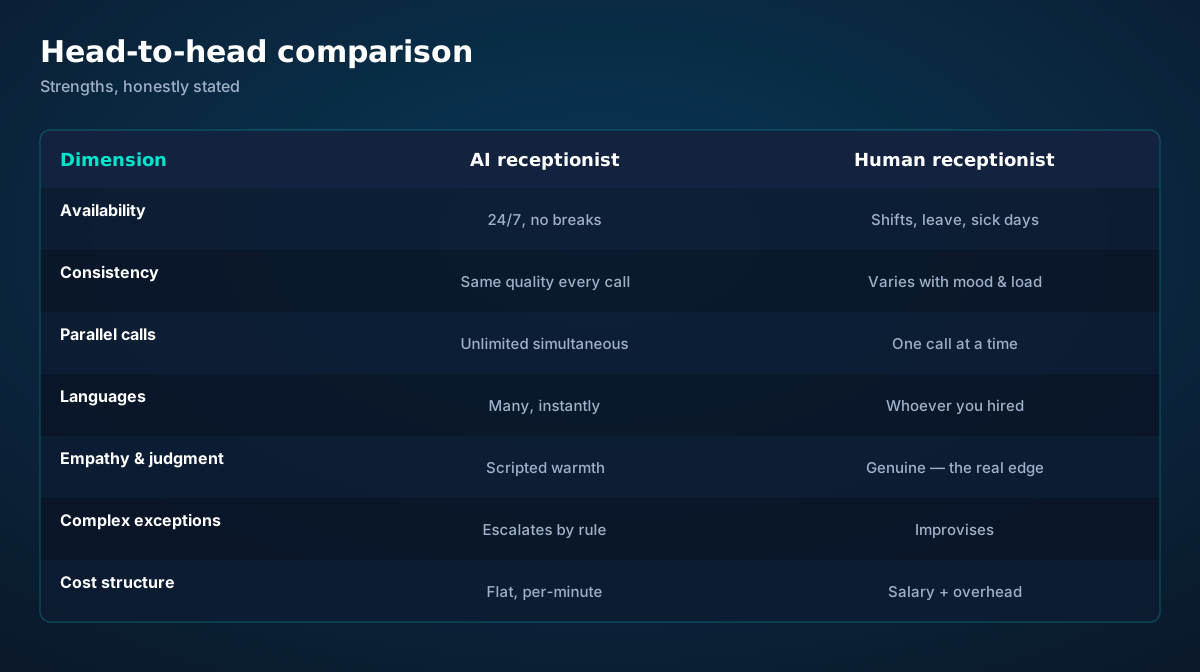
Head-to-head comparison matrix of AI vs human receptionists across availability, consistency, parallel calls, languages, empathy, complex exceptions, and cost structure
Seven dimensions. AI sweeps the structural ones; humans own the human ones.

Availability. This is the AI's biggest and least arguable win. Humans work shifts; they take lunch, vacations, and sick days. Nights, weekends, and holidays are either unstaffed or staffed at premium cost. An AI receptionist answers at 3 a.m. on Christmas with the same quality as 10 a.m. on Tuesday. Every comparison starts here, because every missed call is a customer talking to a competitor instead.

Consistency. Humans have bad days, get flustered during rushes, and occasionally give the wrong price from memory. AI gives the same correct answer every time, with the same patient tone, on the ten-thousandth repetition. For FAQ-heavy front desks, consistency alone justifies the technology.

Parallel capacity. A human handles one call at a time; the second caller waits on hold. An AI handles as many simultaneous calls as you need — the tenth concurrent caller gets the same instant answer as the first. Businesses with spiky demand (Monday mornings, ad campaigns, storm season for roofers) feel this most.

Languages. Hiring multilingual front-desk staff is expensive and fragile — lose one person and you lose a language. AI switches languages mid-conversation at no marginal cost. In diverse markets this isn't a nice-to-have; it's market access.

Empathy and judgment. This is the human stronghold, and it's not close. A person reads tone, hesitation, and distress; they know when the policy manual is wrong; they improvise. AI can sound warm, but warmth performed is not warmth felt — and callers in genuinely difficult moments can tell.

Complex exceptions. Related to judgment: the truly novel situation — the request that doesn't fit any category, the angry customer with a legitimate grievance, the delicate negotiation. Humans navigate these; AI should be designed to recognize them and escalate fast.

Cost structure. Humans cost salary plus benefits, training, management overhead, and turnover — and the cost scales roughly linearly with coverage: double the hours, roughly double the cost. AI costs per minute of talk time, nearly flat whether it's one call or fifty at once. Neither is "cheaper" in the abstract; they scale differently, which matters enormously as you grow.

Chapter 3 · Money

How the costs actually behave

We won't quote you prices here — anyone else's numbers would be invented, and ours aren't final until launch. What's real and worth understanding is the shape of the costs.
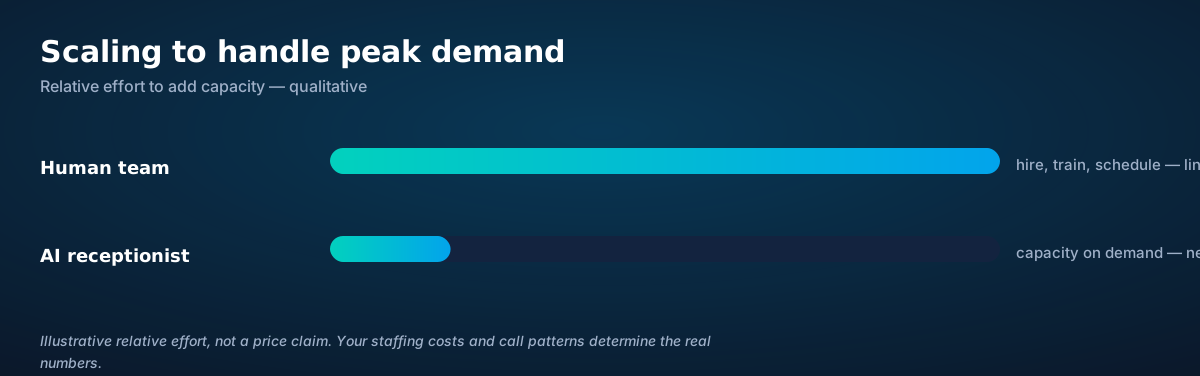
Qualitative chart showing the relative effort of adding call capacity: human teams scale linearly while AI capacity stays near-flat
Illustrative, not a price claim: adding capacity gets linearly more expensive with humans, and stays nearly flat with AI.

Human reception has high fixed costs and linear scaling. One full-time receptionist covers ~40 hours a week; covering 24/7 takes four to five people with shift differentials, and every additional simultaneous call needs another human. There's also the hidden tax: recruiting, training (a new hire takes weeks to learn your business), turnover (front-desk roles churn), and management time.

AI reception has low fixed costs and usage-based scaling. You pay for the minutes you use. Ten simultaneous calls cost roughly ten times one minute — but you were going to pay for those minutes anyway, and there's no hiring, training, or scheduling. The cost curve is nearly flat against concurrency, which is exactly where human staffing breaks.

The crossover point: if your call volume is low, steady, and entirely within business hours — and your receptionist also does in-person greeting, office management, and coffee — a human is probably the better value. If you miss calls after hours, drown during peaks, or pay for coverage you barely use, the math flips hard toward AI. Most small businesses live somewhere in between, which is why the hybrid model exists.

Chapter 4 · Strengths

Where each side wins — specifically

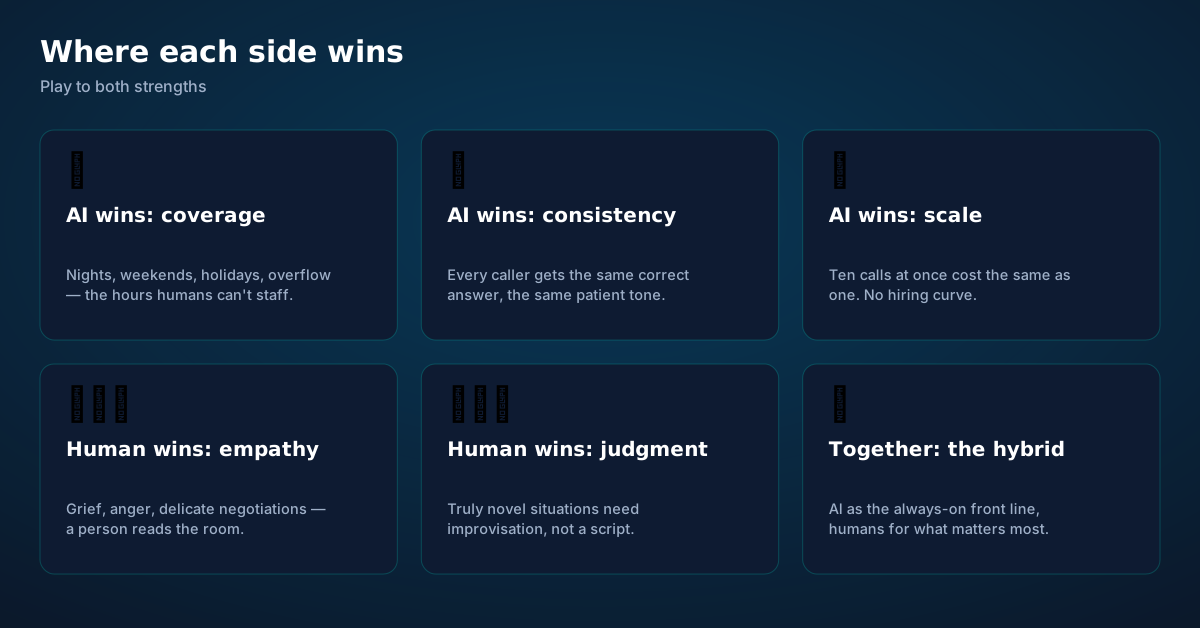
Cards showing where AI wins (coverage, consistency, scale) and where humans win (empathy, judgment), plus the hybrid combination
Play to both strengths instead of forcing one side to do the other's job.

AI wins: coverage. Nights, weekends, holidays, lunch breaks, sick days, the fifteen minutes everyone's in a meeting. These are the hours where human staffing is either impossible or economically absurd — and they're exactly the hours AI covers at the same quality as prime time.

AI wins: consistency. The hundredth "what are your hours?" gets the same warm, correct answer as the first. No bad moods, no misremembered prices, no "I think we're closed… actually let me check."

AI wins: scale. Marketing works? Great — fifty people call at once, and fifty people get answered. With humans, success becomes a busy signal.

Human wins: empathy. Grief, fear, anger, confusion — the moments where being heard matters more than being helped. A funeral home, a medical practice delivering bad news, a customer who's been wronged: these need a person, full stop.

Human wins: judgment. The situation the manual doesn't cover. The regular customer who deserves an exception. The subtle read that this caller is about to cancel a big contract and needs saving. Improvisation is still a human monopoly.

Chapter 5 · The synthesis

The hybrid: one phone line, two intelligences

Here's the setup outperforming both pure options: the AI answers every call first. It resolves the routine — the bookings, the FAQs, the messages, the status checks — which is typically the large majority of front-desk volume. The moment a call needs a human — urgency keywords, emotional distress, a VIP, a request it can't confidently handle — it transfers live, with full context.
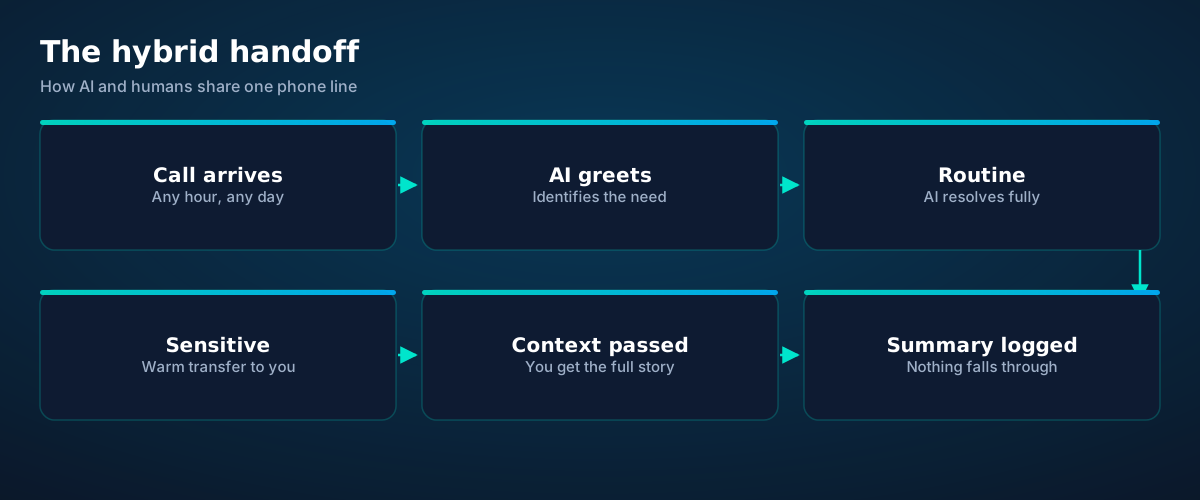
Hybrid handoff flow: AI answers, resolves routine calls, transfers sensitive ones to a human with context, and logs everything
The AI is triage; the human is the specialist. Emergency rooms figured this out decades ago.

The economics are compelling: you stop paying humans to be bored at a desk at 9 p.m., and you stop losing the callers who used to get voicemail. Your staff spends their phone time on the calls that actually need them — which, not coincidentally, is also the work they find meaningful.

The operational key is escalation design: explicit rules for what transfers, to whom, and when. "Transfer on the words emergency, lawyer, or cancel; transfer callers who've called three times today; transfer anyone who asks twice for a person." Write the rules, review the transcripts weekly for the first month, refine. The hybrid gets smarter; a pure-human desk just gets tired.
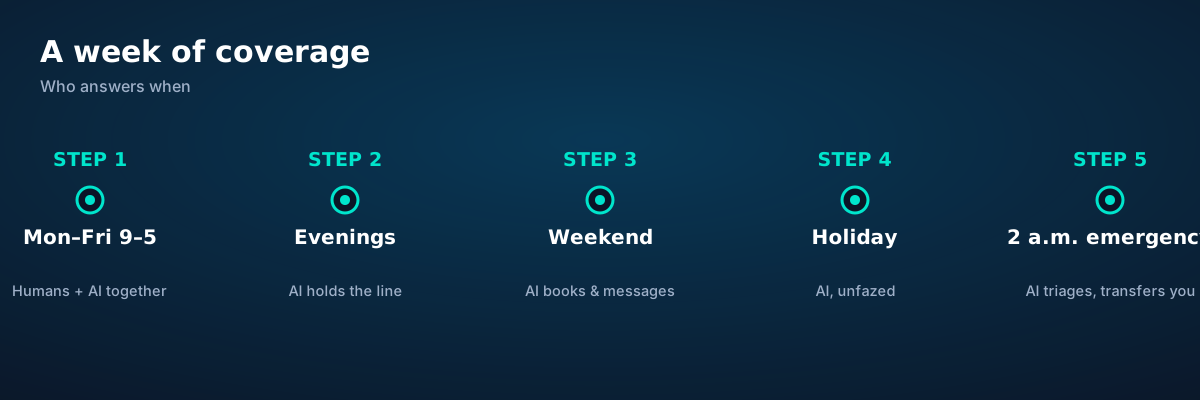
Week coverage timeline: humans and AI together on weekdays, AI covering evenings, weekends, holidays, and 2 a.m. emergencies
Coverage across the week. Notice the AI isn't replacing the weekday team — it's covering everything around them.
Chapter 6 · Decision

Which setup fits your business?

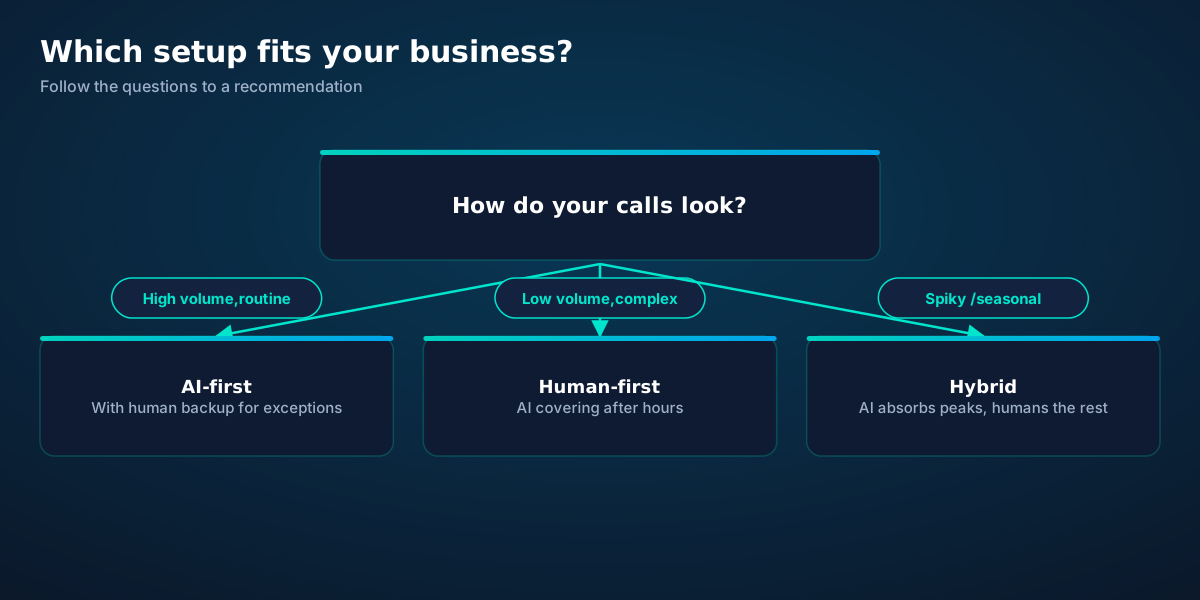
Decision tree: high routine volume leads to AI-first, low complex volume to human-first, spiky seasonal demand to hybrid
Start from your call patterns, not from the technology.

AI-first fits when volume is high and routine: appointment businesses, property management, home services with standardized offerings. Humans remain as escalation for the exceptions — maybe 10–20% of calls.

Human-first fits when volume is low and every call is complex or sensitive: boutique advisory, therapy practices, high-touch B2B sales. Add AI purely as after-hours coverage so nights and weekends stop leaking.

Hybrid from day one fits spiky or seasonal demand, growing businesses, and anyone who misses calls today. It's also the easiest to start: point after-hours calls at the AI first, measure for a month, then expand into overflow and daytime.

Whichever you choose, audit first: log two weeks of calls by type — booking, FAQ, message, urgent, spam. The distribution tells you exactly how much an AI can absorb and what must stay human. Most businesses are surprised by how routine their "complex" calls turn out to be.

Start hybrid with Tele Agent. esimgomobile's AI receptionist launches on real virtual numbers with warm human transfer built in — AI-first, human-backed, from day one. See how Tele Agent works.
Questions

Before you ask.

Will an AI receptionist make my business feel impersonal?
Only if it's badly configured. Callers judge by outcome, not by ontology: a fast, competent, warm AI beats a rushed human who puts them on hold. The impersonal feeling comes from menus and voicemail, not from good conversational AI — and the system should always identify itself honestly.
Can I keep my human receptionist and add AI?
Yes — this is the hybrid model, and it's the most common successful deployment. The AI covers nights, weekends, lunch, and overflow; your receptionist handles walk-ins, complex cases, and everything that benefits from a human touch. Many businesses find their receptionist becomes more effective, not less needed.
What about callers who insist on a human?
Any good system transfers on request — "let me get someone for you" should work the first time, every time. Fighting the caller is a configuration failure. Design the escape hatch first, then the automation.
How do I compare costs without vendor price sheets?
Calculate your current cost per handled call: fully-loaded receptionist cost divided by calls actually answered (not just received — missed calls cost you too, in lost business). Then ask AI vendors for their per-minute pricing and estimate your monthly minutes. The honest comparison includes the value of calls you'd otherwise miss.
Do I need to fire anyone to use an AI receptionist?
No. Most deployments reassign rather than replace: the AI absorbs routine volume and the humans focus on in-person customers, complex cases, and higher-value work. Businesses that frame it as "the AI takes the boring calls" get staff buy-in; businesses that frame it as replacement get resistance and worse service.
Live now

Get connected today.

Monthly plans from $8/mo, travel packs from $3.65. Real checkout, no waiting.

See plans and pricing

Up close

From the article to your phone.

Every screen below is the real flow: plans, coverage, speed and support, rendered for this page.
esimgomobile.com
Man taking photo out of airplane window, capturing wing view with smartphone.
AI Receptionist vs Human: Honest Comparison
Travel guides · 8 min read
From the blog: “AI Receptionist vs Human: Honest Comparison” — travel guides in about eight minutes.
  1. 1Checkout shows the full price before you pay. Nothing hidden.
  2. 2Amazon Pay handles payment securely; taxes are calculated for you.
eSIM installedYour AI Receptionist vs Human: Honest plan is ready.
Push · just now
Push notification on AI Receptionist vs Human: eSIM installed, plan ready to activate.
  1. 1Coverage status at a glance: data live, number available, 5G ready.
  2. 2Green means go — no guessing about what's supported.
esimgomobile.com
API quickstart
curl https://api.esimgomobile.com/v1/esims \
  -H "Authorization: Bearer $KEY" \
  -d '{"country":"AI"}'
200 OK · 169 ms
REST API behind AI Receptionist vs Human: issue eSIMs programmatically — 200 OK in milliseconds.
  1. 1Three plans side by side so the trade-off is obvious.
  2. 2Pick by trip length, not by decoding fine print.
Support
How does AI Receptionist vs Human work?
Enter your trip details and get an instant answer — no account needed.
Support snippet — AI Receptionist vs Human: what it does, in one honest answer.
  1. 1A real traveler quote, tied to the destination it mentions.
  2. 2Reviews reference actual trips, not generic praise.
Coverage
195
destinations live
AI Receptionist vs Human: Honest5G ready
Check coverage
Coverage at a glance for AI Receptionist vs Human: 195 destinations live, fastest local partner selected on its own.
  1. 1The plan card shows exactly what you're buying — data, days, destination.
  2. 2One tap starts the two-minute QR install.
Speed test
810Mbps
5G · AI Receptionist vs Human: Honest · 68 ms
Illustrative speed readout on AI Receptionist vs Human: 810 Mbps, 68 ms — example figures, not live measurements.
  1. 1The Tele Agent answers in plain language — no telecom jargon.
  2. 2Every answer is specific to your trip, not a generic FAQ.
60%
data left
Usage ring on AI Receptionist vs Human — 60% of data left: the number travelers check most.
  1. 1Signal widget: network generation and destination, always visible.
  2. 2Five bars, zero ambiguity about what you're connected to.
Virtual number
+1 205 869 2442
Routes toAI Receptionist vs Human: Honest
SMS + voiceEnabled
Your second line on AI Receptionist vs Human: +1 205 869 2442 — real number, SMS and voice enabled.
  1. 1A real traveler quote, tied to the destination it mentions.
  2. 2Reviews reference actual trips, not generic praise.
esimgomobile.com
Checkout
Atlas 50GB — AI Receptionist vs Human: Honesttotal
Taxescalculated
Pay securely
256-bit encrypted · Amazon Pay
Secure checkout on AI Receptionist vs Human: Atlas 50GB, full price up front, no fine print.
  1. 1Checkout shows the full price before you pay. Nothing hidden.
  2. 2Amazon Pay handles payment securely; taxes are calculated for you.
AI Receptionist vs Human: Honest · 5G
Signal widget on AI Receptionist vs Human: network generation and place, always visible.
  1. 1Usage ring compresses the whole plan into one glanceable number.
  2. 2Percent remaining is the only metric most travelers check.
$8
entry monthly plan
launch fact
Launch fact behind AI Receptionist vs Human: $8 entry monthly plan — a fixed figure, not live telemetry.
  1. 1The roaming math, made visible: one price versus per-day carrier fees.
  2. 2This is the comparison most travelers never see until the bill.

eSIM plan
Atlas 20GB20 GB · 30 days
AI Receptionist vs Human: Honest
Install eSIM
Atlas 20GB on AI Receptionist vs Human — 20 GB · 30 days, prepaid with the full price shown before you pay.
  1. 1The Tele Agent answers in plain language — no telecom jargon.
  2. 2Every answer is specific to your trip, not a generic FAQ.
Atlas Unlimited
Unlimited · 30 days
AI Receptionist vs Human: Honest
Atlas Unlimited — Unlimited · 30 days, prepaid and ready on AI Receptionist vs Human.
  1. 1Usage ring compresses the whole plan into one glanceable number.
  2. 2Percent remaining is the only metric most travelers check.
Language
Português日本語Français
Language picker on AI Receptionist vs Human — Português, 日本語, Français: the app speaks six languages.
  1. 1The plan chip: name, allowance and destination in one line.
  2. 2Everything you need to confirm you're on the right plan.
Launch facts
195destinations live
31free tools
$8entry monthly plan
Launch facts behind AI Receptionist vs Human — 195 destinations live, 31 free tools, $8 entry monthly plan: numbers we publish and stand behind.
  1. 1Coverage pins show where partner networks are live.
  2. 2The map answers the only question that matters: will it work there?
Install
1 Scan2 Add3 Go
The AI Receptionist vs Human install: QR in three steps — scan, add, go, about two minutes.
  1. 1The plan card shows exactly what you're buying — data, days, destination.
  2. 2One tap starts the two-minute QR install.
Why travelers pick it
  • 24/7 support
  • Keep WhatsApp number
  • Instant QR install
Why travelers pick AI Receptionist vs Human: 24/7 support, Keep WhatsApp number, Instant QR install.
  1. 1The roaming math, made visible: one price versus per-day carrier fees.
  2. 2This is the comparison most travelers never see until the bill.
Sjuan Dogjani
Get connected
1 Pick a plan2 Scan QR3 Land online
Three steps on AI Receptionist vs Human: pick a plan, scan the QR, land online.
  1. 1A real traveler quote, tied to the destination it mentions.
  2. 2Reviews reference actual trips, not generic praise.
Network
5G
AI Receptionist vs Human: Honest connected
Network widget for AI Receptionist vs Human: 5G, full bars — zero ambiguity about the connection.
  1. 1The Tele Agent answers in plain language — no telecom jargon.
  2. 2Every answer is specific to your trip, not a generic FAQ.
My eSIM
86%10 GB left
Days left16
Top up+10 GB
Data dashboard on AI Receptionist vs Human: 86% remaining, days left, top-up one tap away.
  1. 1Live usage ring: see remaining data at a glance, no mental math.
  2. 2Top-up button sits right where you need it when data runs low.

Altaf Shah — Street level: navigation, rideshares and reviews, all instant.
Street level: navigation, rideshares and reviews, all instant.
hiker expressing satisfaction after climbing a mountain — Hiking the ridge: trail map offline, emergency numbers saved.
Hiking the ridge: trail map offline, emergency numbers saved.
a man in green jacket carrying a brown backpack — Rainy-day backup plan: indoor attractions researched from the hostel bunk.
Rainy-day backup plan: indoor attractions researched from the hostel bunk.
close up photo of person using smartphone — Island time, online time: ferries, beaches and full signal.
Island time, online time: ferries, beaches and full signal.
stein egil liland — Coast roads and country lanes — the map keeps up wherever you roam.
Coast roads and country lanes — the map keeps up wherever you roam.
person standing on the mountain — The commute, handled: podcasts downloaded, messages sent, no dead zones.
The commute, handled: podcasts downloaded, messages sent, no dead zones.
MART PRODUCTION — Rain or shine, the connection holds — weather doesn't throttle data.
Rain or shine, the connection holds — weather doesn't throttle data.
glass with a drink and a straw by a laptop — The modern arrival: online before the seatbelt sign goes off.
The modern arrival: online before the seatbelt sign goes off.
man holding mobile phone in black and white — The departure board flips: gate found, lounge located, all on the eSIM.
The departure board flips: gate found, lounge located, all on the eSIM.
excited multiethnic friends jumping above sandy sea beach in summer — The long layover: streaming, working and messaging, all covered.
The long layover: streaming, working and messaging, all covered.
church on sea shore — Rainy-day backup plan: indoor attractions researched from the hostel bunk.
Rainy-day backup plan: indoor attractions researched from the hostel bunk.
person holding smartphone with stylish case — Night markets and late trains — connected the whole way through.
Night markets and late trains — connected the whole way through.
vibrant night cityscape of shinjuku tokyo — Rooftop check-in: boarding passes and hotel keys, all on the phone.
Rooftop check-in: boarding passes and hotel keys, all on the phone.
Bhargava Marripati — Island time, online time: ferries, beaches and full signal.
Island time, online time: ferries, beaches and full signal.
aerial view of midtown manhattan skyscrapers — City lights after dark — the eSIM doesn't care what time it is.
City lights after dark — the eSIM doesn't care what time it is.
three people working in the office — Trailheads and lookouts: offline maps downloaded, just in case.
Trailheads and lookouts: offline maps downloaded, just in case.
colleagues talking in an office — Real journeys, real connectivity — this is what the product is for.
Real journeys, real connectivity — this is what the product is for.
airplane wing view against clear blue sky — Family group chat: location shared, dinner plans settled in minutes.
Family group chat: location shared, dinner plans settled in minutes.
black toyota noah driving down the street in tokyo — The food tour: every recommendation looked up on the spot.
The food tour: every recommendation looked up on the spot.
Mikhail Nilov — Platform to platform: tickets, timetables and taxis in one hand.
Platform to platform: tickets, timetables and taxis in one hand.

Explainer

Key takeaways

  • Setup beats improvisation — every tip in this article works best arranged before departure.
  • Match the plan to the trip length and your heaviest single use-case, then stop thinking about it.
  • The core idea: AI Receptionist vs Human: Honest Comparison matters because connectivity shapes the whole trip, not just the phone bill.
  • When something goes wrong abroad, the fix is almost always: toggle airplane mode, check the eSIM line is enabled, then ask the Tele Agent.
  • Data-first eSIMs keep your number and your apps; the only thing that changes is the price.

Explainer

Putting it into practice

Then run through the travel tips checklist above. Ten minutes of preparation saves hours of airport problem-solving.

Install the eSIM now — it costs nothing to have it sitting on your phone waiting. Activation happens when you say so.

Reading about AI Receptionist vs Human: Honest Comparison is step zero. Step one is a two-minute action: check your phone is unlocked and eSIM-capable, then pick a plan sized to your next trip.

Go deeper

And the Tele Agent will walk through any of this conversationally if you'd rather talk than read.

The tools index turns article advice into instant answers — coverage checks, plan pickers and compatibility checks that take seconds.

Explainer

Common mistakes to avoid

  • Forgetting two-factor: banks text your home number — keep that SIM active.
  • Assuming hotel Wi-Fi will do: it won't, at the exact moment you need it most.
  • Ignoring the 80% alert: top up early; data never gets cheaper mid-trip.
  • Disabling the wrong line: label your eSIM clearly in phone settings.
  • Buying data at the airport: the most expensive megabyte is the panicked one.

See the math

The numbers behind AI Receptionist vs Human: Honest Compari.

AI Receptionist vs Human: Honest Comparison — data dashboard

The numbers behind the story, switchable by dataset.

3
steps to connect
pick, scan, land
195
destinations
one eSIM
~2 min
install time
QR code
24/7
support
human + AI
Maps & navigation: ≈5 MB/hourMaps & nav ≈200 h / GBMessaging & email: ≈20 MB/hourMessaging ≈50 h / GBSocial browsing: ≈150 MB/hourSocial ≈6.7 h / GBVideo calls: ≈600 MB/hourVideo calls ≈1.7 h / GBHD streaming: ≈1.5 GB/hourStreaming ≈40 min / GB
Atlas 5GB: 5 GB — Weekend breaks & light useAtlas 5GB 5 GBAtlas 20GB: 20 GB — Two-week trips & daily useAtlas 20GB 20 GBAtlas 50GB: 50 GB — Remote work & hotspottingAtlas 50GB 50 GBAtlas Unlimited: Unlimited — Heavy use, zero meteringAtlas Unlimited Unlimited
Illustrative — Wk 1: 90% of maxIllustrative — Wk 2: 62% of maxIllustrative — Wk 3: 38% of maxIllustrative — Wk 4: 15% of maxWeek 1Week 2Week 3Week 4IllustrativeIllustrative 20 GB burn-down at moderate use — your mileage varies.

Hover any bar or point for its exact value. Tabs switch datasets — everything on this panel is computed from live product data unless labeled illustrative.

AI Receptionist vs Human: Honest Comparison — data dashboard. Usage rates, plan sizes and a typical burn-down curve — the numbers behind “AI Receptionist vs Human: Honest Comparison”.
Pro tipsFour habits of the always-connectedPro tipsSmall habits, big difference.1Install before you flyAirport Wi-Fi is the worst place to set up connectivity.2Screenshot bookingsHotel address & confirmations, available with no signal.3Check unlock statusCarrier-locked phones can't add an eSIM — verify first.4Set an 80% alertA top-up should never surprise you mid-trip.
Pro tips. Veterans do all four without thinking.
Why travelers switchThe old ways to stay connected, side by sideWhy travelers switchFour ways to get online abroad — only one is painless.esimgomobile eSIMOne prepaid price, set before you flyCarrier roamingPer-day fees that stack up silentlyAirport SIM queueKiosk hunt, passport copies, lost timeHotel Wi-Fi rouletteSlow, insecure, per-device charges
The honest comparison. One prepaid price versus per-day fees: the math, made visible.
What your gigabytes meanTypical hourly usage per activityWhat your gigabytes meanTranslate plan sizes into real travel behavior.Maps & navigation≈ 5 MB / hourMessaging & email≈ 20 MB / hourSocial browsing≈ 150 MB / hourVideo calls≈ 600 MB / hourHD streaming≈ 1.5 GB / hourTypical usage rates — actual consumption varies by app and quality settings.
Data usage guide. Maps sip, streaming gulps: size the plan to your heaviest habit.
Get connected in three stepsFrom purchase to online in about two minutesGet connected in three stepsNo store visit, no plastic SIM, no waiting for the post.1Scan the QR codeThe eSIM installs straight onto your phone. No store, no plastic SIM.2Pick your planChoose data for your trip — checkout takes about two minutes.3Land connectedSwitch the line on when you arrive — online before baggage claim.
Three-step setup. Install days before departure or minutes before boarding — your call.
Every plan includesNo tiers of basic dignity — these ship with all plansEvery plan includesThe baseline is generous on purpose.Hotspot includedShare with your laptop or tablet at no extra cost.6 languagesThe app speaks your language, wherever you're from.One-tap top-upMore data in seconds — no new QR code.5G where availableFastest local partner network, selected automatically.Keep your WhatsAppYour existing number keeps working on the data line.24/7 supportReal humans plus the Tele Agent, around the clock.
Included with every plan. From 5 GB to Unlimited, the inclusions don't shrink.
TakeawaysIf you remember nothing else, remember thisTakeawaysThe article in four sentences.Install earlyBuy before you fly — setup takes two minutes, not two hours.Size it right5 GB weekends, 20 GB fortnights, 50 GB+ for work trips.Prepaid = calmNo contracts means no surprise charges, ever.eSIM firstFor most trips, a prepaid eSIM beats roaming on price and convenience.
Takeaways. Four sentences carrying the whole of AI Receptionist vs Human: Honest Comparison.
Questions, answeredThe six things everyone asks firstQuestions, answeredShort answers, no sales pitch.Does hotspot work?
Yes — share your connection with laptop or tablet.
Which phones work?
Any carrier-unlocked, eSIM-capable iPhone or Android.
What if data runs out?
80% alert, then one-tap top-up. No bill shock.
Is it a contract?
No — prepaid. Service simply stops instead of charging extra.
How fast is setup?
About two minutes: plan, QR scan, done.
Do I keep my number?
Yes — WhatsApp & iMessage keep working on your existing number.
FAQ at a glance. Still curious? The Tele Agent answers anything else instantly.
AI Receptionist vs Human: Honest Comparison: key numbersThe figures behind the storyKey numbersThe figures this guide keeps coming back to.3steps to get connectedesimgomobile network data195destinations coveredesimgomobile network data2 minto install an eSIMesimgomobile network data24/7support, human + AIesimgomobile network dataNumbers from the esimgomobile network — verified, not vibes.
Key numbers. The four figures anchoring AI Receptionist vs Human: Honest Comparison.
Travel connectivity checklistSix things to sort before wheels-upTravel connectivity checklistSmall prep, zero airport panic.Keep home SIM for 2FABank codes still arrive while data runs on the eSIM.Check unlock statusCarrier-locked phones can't add an eSIM — verify first.Download offline mapsThey save data and work in dead zones.Screenshot bookingsHotel address & confirmations, available with no signal.Set an 80% alertA top-up should never surprise you mid-trip.Install before you flyAirport Wi-Fi is the worst place to set up connectivity.
Pre-flight checklist. Six habits, ten minutes of prep — the AI Receptionist vs Human: Honest Comparison checklist.
Your action planTurn reading into doingYour action planFour moves from this page to connected.1Check your phoneCarrier-unlocked and eSIM-capable? You're good to go.2Pick a planMatch gigabytes to trip length — the matrix above helps.3Install the eSIMScan the QR code. Two minutes, done.4Land connectedSwitch the line on at arrival and go.
Action plan. Reading is step zero — the action plan is steps one to four.

Start your trip online

Prepaid, no contracts, no roaming surprises. The whole setup takes about two minutes.

See plans and pricing Talk to the Tele Agent