The idea in one paragraph.
Call forwarding redirects calls made to one number so they ring somewhere else — another phone, a colleague, a voicemail box, an entirely different country. The caller dials your number and never knows the detour happened; the network simply delivers the call to the destination you configured instead of to you.
It’s been around since the electromechanical exchanges, and it survives because the need never went away: people move, but numbers shouldn’t have to. On vacation, in a meeting, phone dead, working from another continent — forwarding is how your number stays reachable when you aren’t where it expects you to be.
Unconditional: forward everything, always.
The blunt instrument. Every call to your number detours to the destination immediately — your phone never rings, never lights up, never knows. Use it when you’re on holiday and a colleague is covering, when an old number should permanently ring the new one, or when a business line should go straight to the answering service overnight.
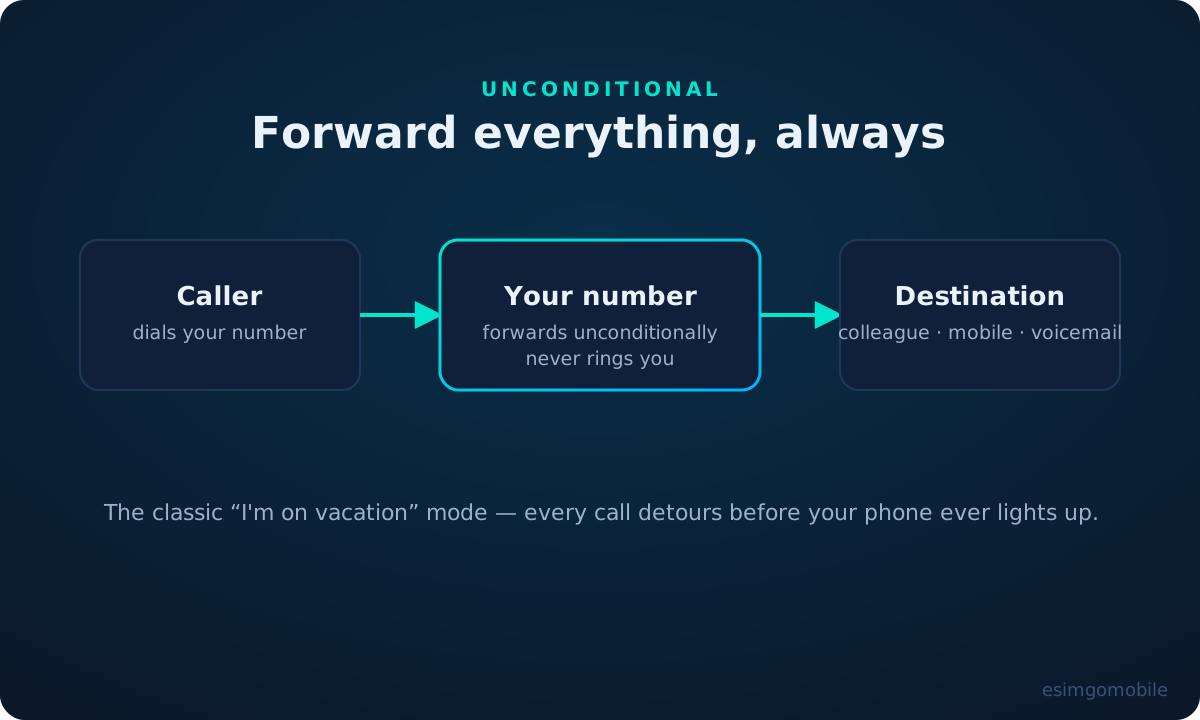
On a virtual number, unconditional forwarding is just a toggle in the dashboard — and it can point at anything: a mobile, another virtual number, a SIP address, or a voicemail box. On a mobile SIM, it’s the *21* code (more on codes below).
Conditional: forward with judgment.
Conditional forwarding only diverts when a condition is met — which covers nearly every real-world “I can’t take this right now” situation:
- Busy — you’re already on a call. The new caller detours instead of getting a busy tone (or instead of call-waiting interrupting you).
- No answer — your phone rings for a while, then gives up gracefully to the destination. The classic “ring me first, then my assistant” setup.
- Unreachable — phone off, airplane mode, no signal, dead battery. The network can’t find you, so it follows your instructions instead.
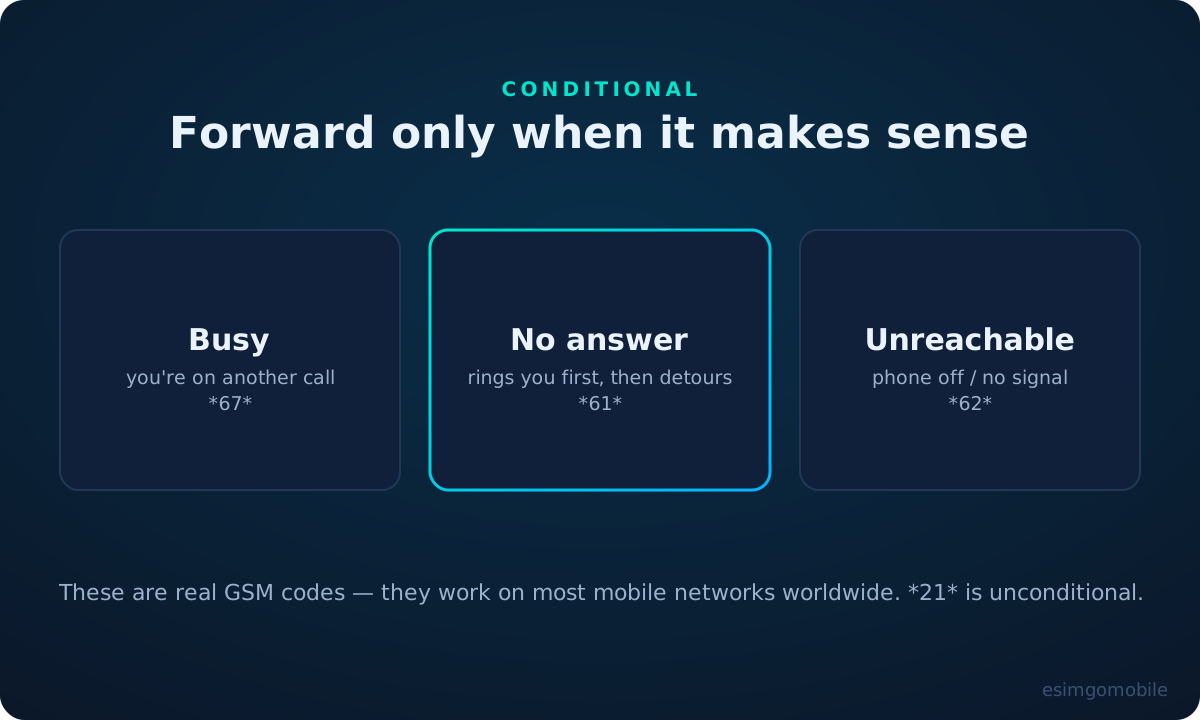
The art is in combining them. A common professional setup: no-answer forwards to a colleague after 20 seconds, unreachable forwards to voicemail, and busy goes to voicemail too — so every possible state of your phone has a planned outcome, and no caller ever hears dead air.
Ring strategies: one call, many phones.
Forwarding to a group instead of a single destination is where it gets powerful:
- Simultaneous ring — every device rings at once; first to answer wins. Fastest, best for small teams where anyone can help.
- Sequential hunt — tries people in order: the specialist, then the backup, then the manager. Best when expertise matters.
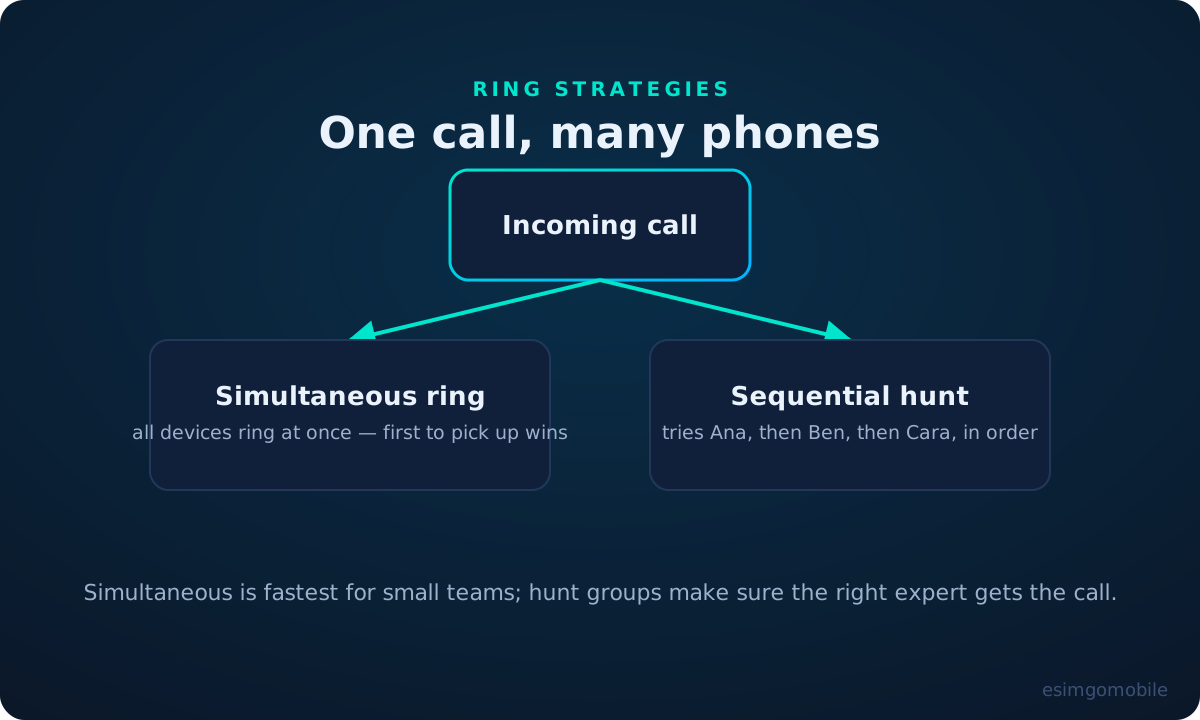
Both can cascade: hunt through the team, then land on voicemail with transcription. The caller experiences one continuous attempt to reach a human — which is exactly what “good phone service” feels like.
How it works under the hood.
Forwarding is really two calls stitched together. The incoming call arrives; your provider either replies with a SIP 302 Moved Temporarily redirect (“call them instead”) or — more commonly — places a new outbound call to the destination and bridges the audio. The caller’s phone never knows; as far as it’s concerned, the call just connected.
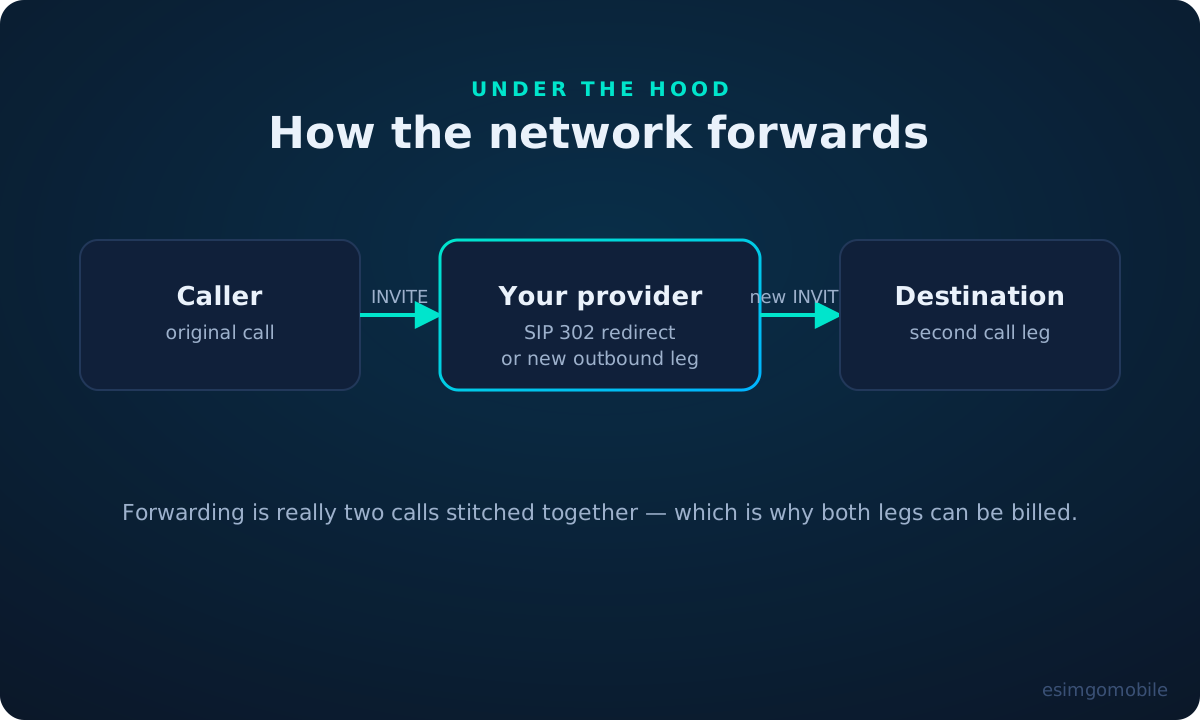
This two-leg reality explains two things people find surprising: why forwarded calls can have slightly more delay (two network paths instead of one), and why they can cost money even when “receiving calls is free” (next section).
The GSM codes that control it.
On most mobile networks worldwide, forwarding is controlled by short codes dialed like phone numbers — a legacy of the GSM standard that still works today:
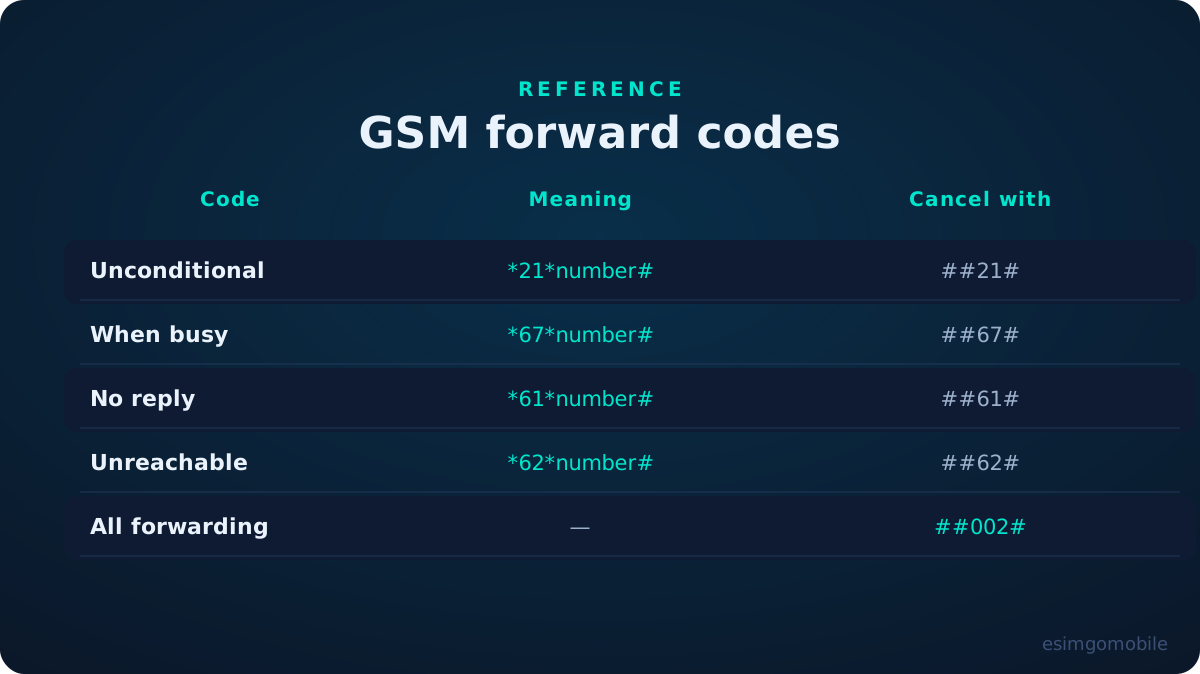
Replace number with the destination in international format. A few notes from the field: some carriers (notably in the US) use their own short codes or app toggles instead; ##002# is the panic button that clears all forwarding when something’s misbehaving; and no-answer forwarding often lets you set the ring delay (e.g. *61*number*11*20# for 20 seconds on many networks).
What forwarding actually costs.
Here’s the part nobody tells you upfront: the forwarded leg is usually billed as an outbound call from your number. Leg one (caller → you) is inbound; leg two (you → destination) is outbound, at whatever rate calling that destination costs. Forward to another mobile and you pay mobile rates for every forwarded minute. Forward internationally and — well, check the rate first.
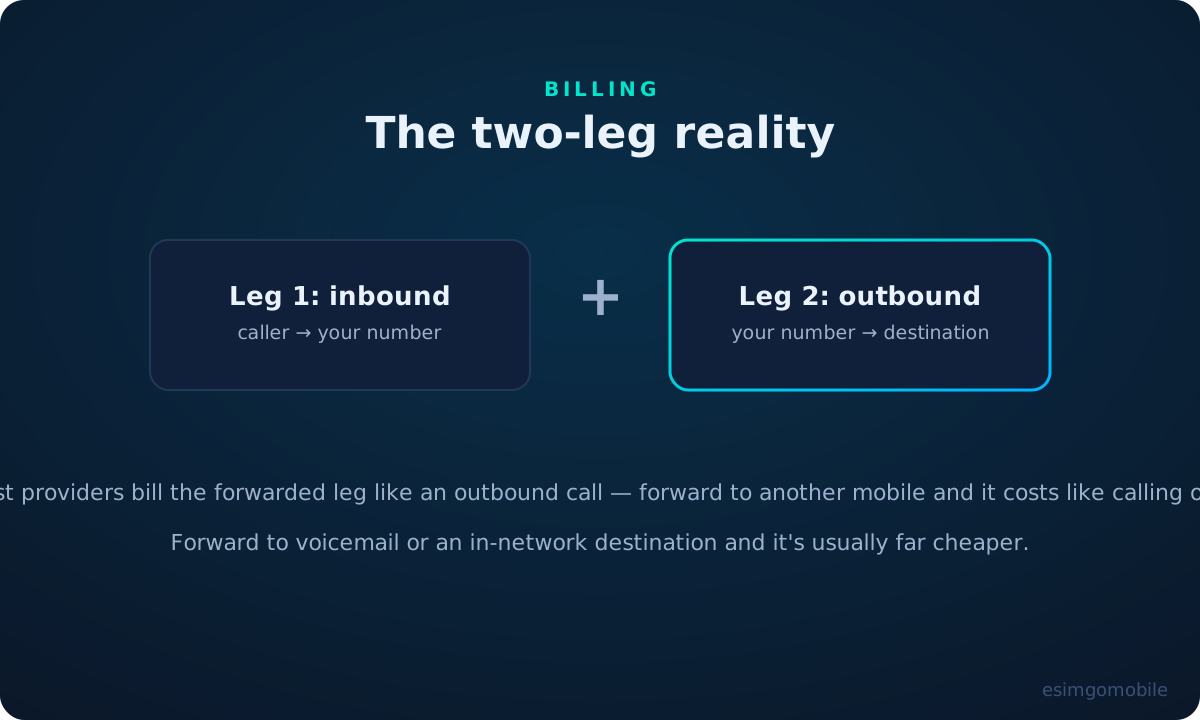
- Cheapest destinations: voicemail, in-network numbers, SIP addresses, and numbers in the same country on flat-rate plans.
- Watch out for: forwarding a business line to a personal mobile full-time (every inbound minute becomes an outbound minute), and international forwarding (per-minute rates apply).
- On virtual platforms like esimgomobile, forwarding to another number on the same platform or to a SIP endpoint is typically far cheaper than carrier forwarding — because the second leg never touches the expensive old phone network.
Rule of thumb: forward to voicemail or in-platform destinations freely; forward to external mobiles deliberately. And always test the full path — a forwarding rule you haven’t tested is a rumor, not a configuration.
Questions, answered.
Does the caller know their call was forwarded?
What’s the difference between forwarding and simultaneous ring?
Can I forward calls internationally?
Why do my forwarded calls sometimes fail?
Is call forwarding the same as call transfer?
Where to go next.
Get your virtual number today.
Virtual numbers are live now — claim yours alongside any eSIM plan.