The problem: the internet has no address.
When you dial 911 from a traditional landline, dispatchers see your address before you say a word — because the number is physically wired to a location. When you dial from a mobile, the network triangulates you from cell towers. When you dial from a VoIP or virtual number, the network knows… your IP address. Which might put you in the right city, the wrong state, or behind a VPN in another country.
This is the entire reason E911 (Enhanced 911) exists for internet telephony: it’s the system that attaches a location to a number that has none by nature, so emergency calls route to the correct dispatch center — the PSAP (Public Safety Answering Point) — with an address the dispatcher can act on.
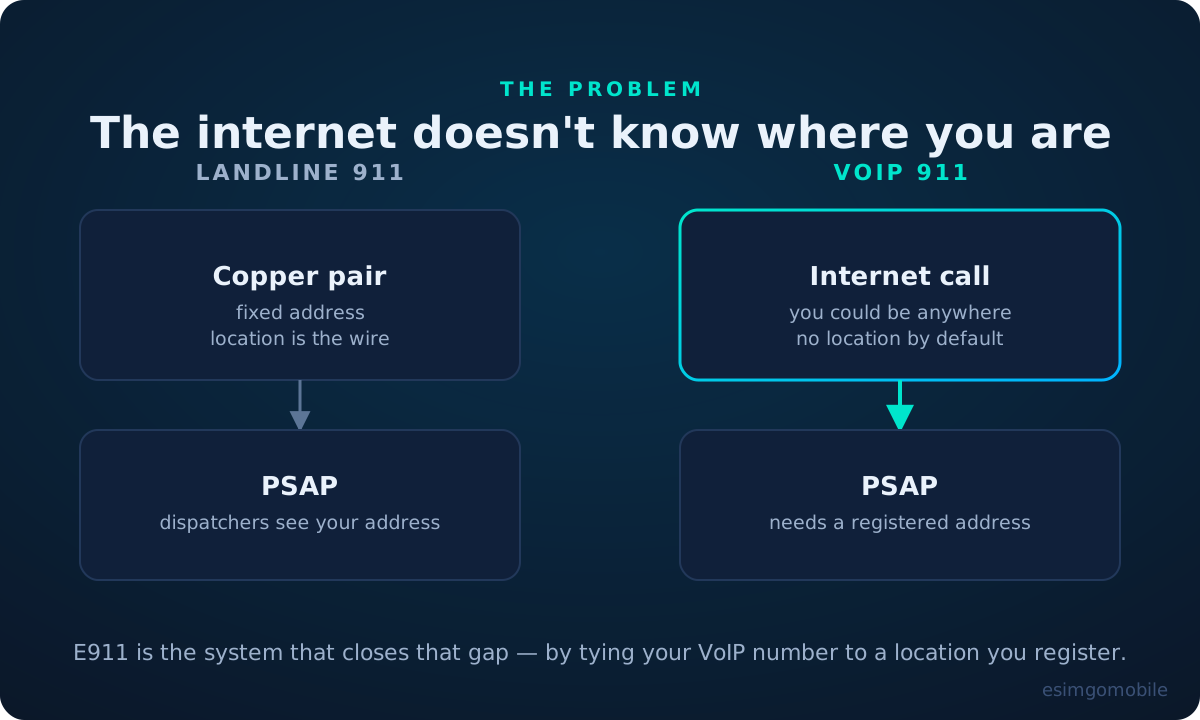
Without E911, a VoIP 911 call is a voice with no location — the worst possible combination in an emergency. Every serious VoIP provider is required to solve this, and the solution starts with an address you register.
The registered location: your address, on file.
The core mechanism is disarmingly simple: you tell your provider where the number is, the provider validates that it’s a real, dispatchable address (not “near the big tree”), and stores it in the 911 database linked to your caller ID. When you dial 911, that address rides along with the call.
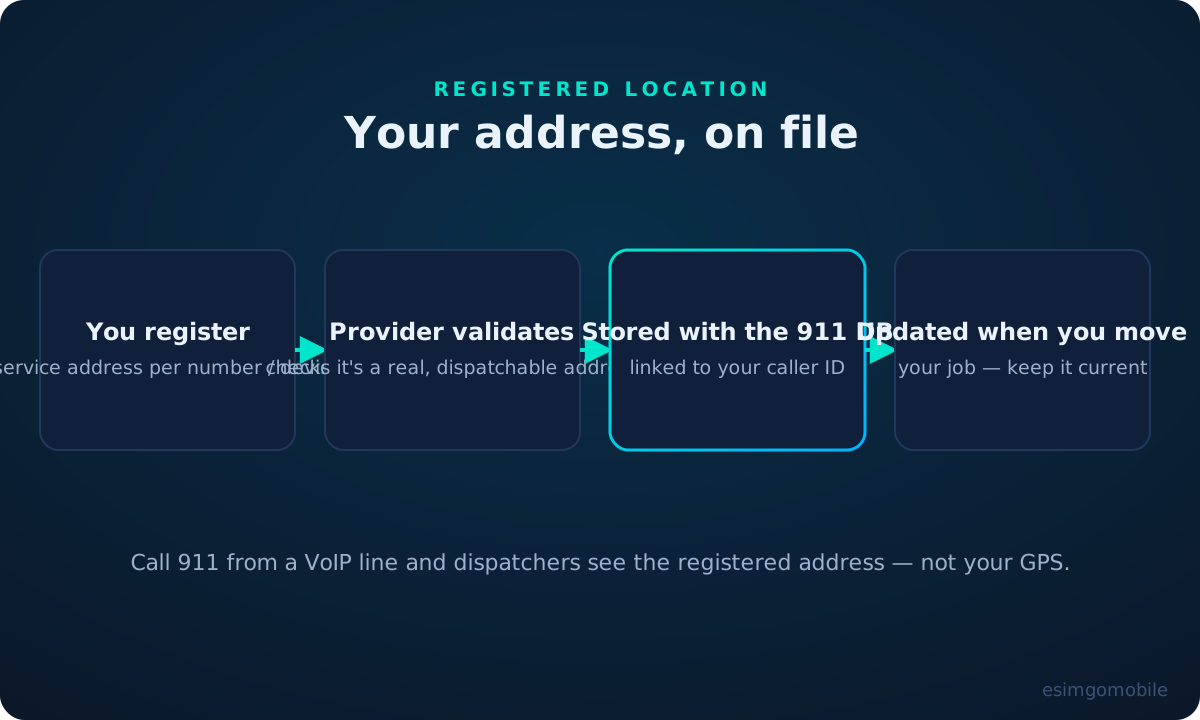
The critical — and most neglected — step is the last one. The registered address is a promise you must keep. Move the VoIP phone to a new office, work from a different city for a month, take the softphone to a cabin — the registered address is now wrong, and in an emergency, responders go to the wrong place. Good providers make updating it a 30-second job; good users actually do it.
How a VoIP 911 call actually routes.
A 911 call from a virtual number takes a special path — it does not go through the normal call routing:
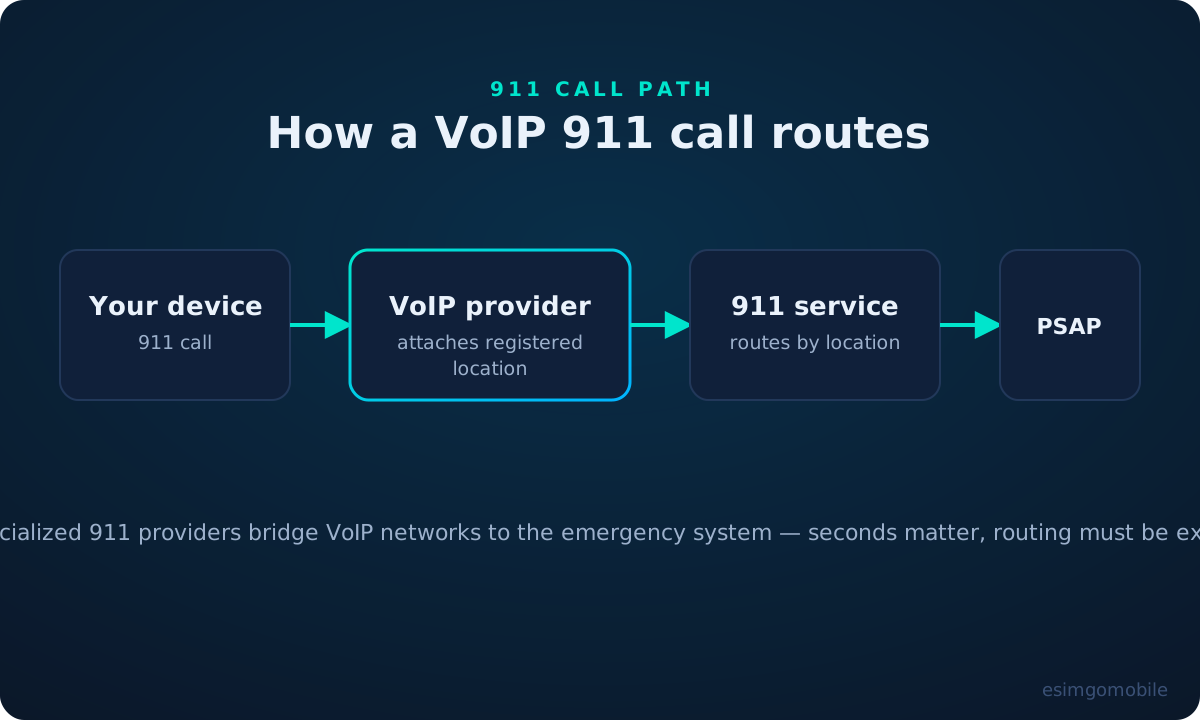
- Your device dials 911. (On a properly configured system, this works even without a dial-out prefix — more on that below.)
- Your VoIP provider recognizes the emergency number, attaches your registered location, and hands the call to a specialized 911 service provider — companies whose entire job is bridging internet telephony to the emergency network.
- The 911 service looks up which PSAP serves your registered address and routes the call there, delivering your location data alongside the voice.
- The PSAP dispatcher sees your registered address on screen and can dispatch even if you can’t speak.
That last point is why location matters more than voice: in the emergencies where seconds count most — a caller who can’t speak, a child, a medical event — the address on the dispatcher’s screen is the rescue.
Fixed vs. nomadic: know your setup.
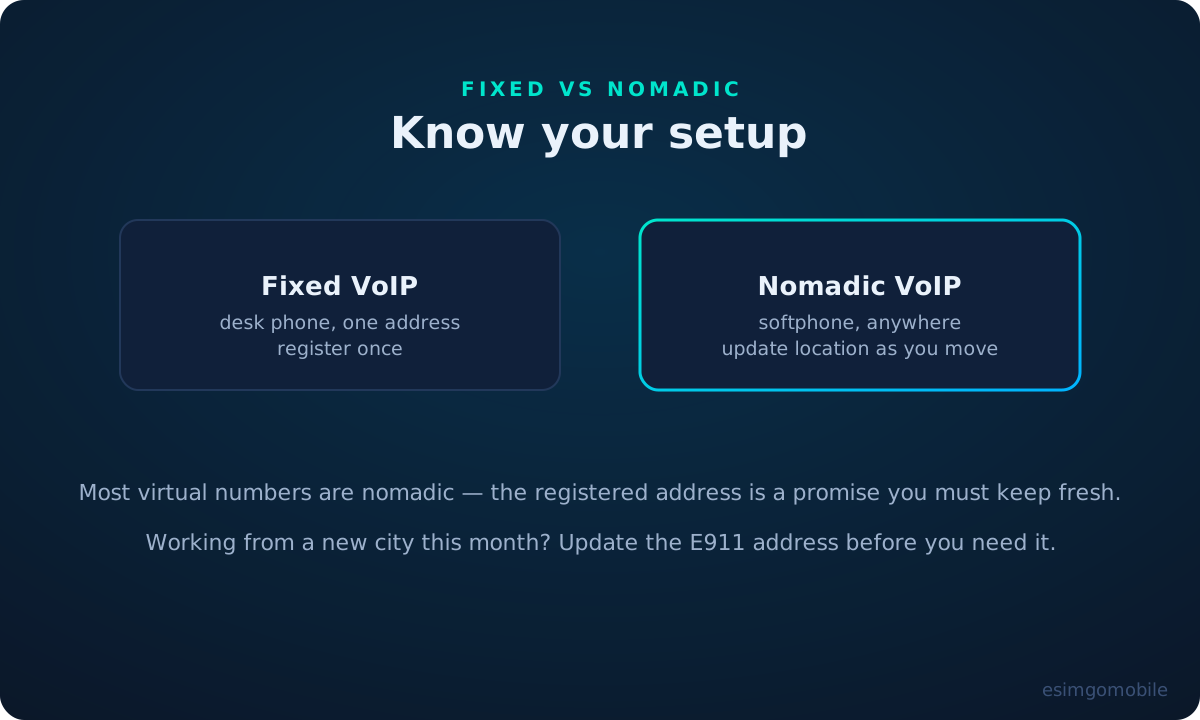
- Fixed VoIP — a desk phone that never moves. Register the address once; it stays correct. This is the easy case.
- Nomadic VoIP — a softphone on a laptop, a virtual number in an app. The device moves; the registered address must move with it. Most virtual numbers are nomadic — which means the update discipline above isn’t optional, it’s the whole system working as designed.
Some providers offer dynamic location — detecting network changes and prompting for updates — but the regulatory baseline everywhere is the registered address. Treat any automation as a helper, not a replacement.
What the rules require (US).
US rules here are specific and worth knowing by name, because they shape what any compliant provider — and any compliant business phone system — must do:
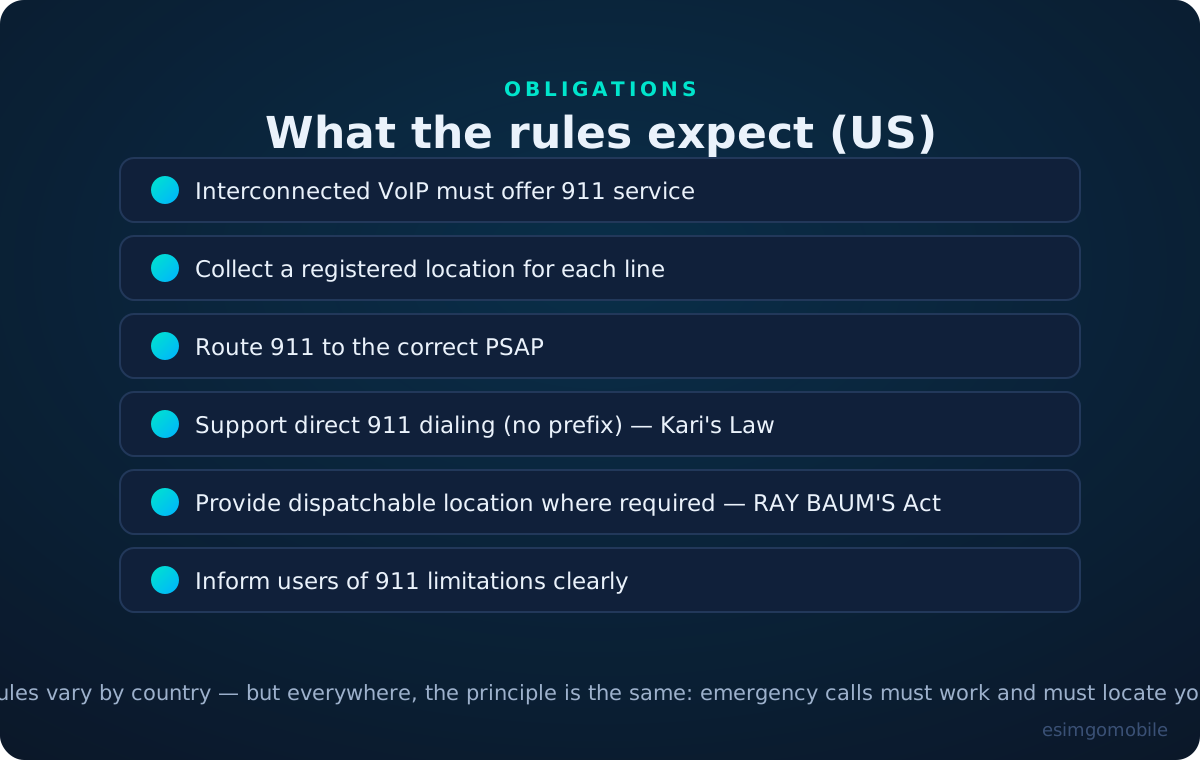
- Interconnected VoIP providers must offer 911. Since the FCC’s 2005 order, any VoIP service that connects to the public phone network has to provide 911 — it’s not optional, and providers must inform customers clearly about any limitations.
- Kari’s Law requires multi-line systems to allow direct 911 dialing — no “dial 9 first” prefix — and to notify on-site personnel (like a front desk or security office) when a 911 call is placed.
- RAY BAUM’S Act, Section 506 — as implemented by the FCC — requires dispatchable location: not just a street address, but the specific location within it (floor, suite, room) so responders find the caller in a large building. Fixed services had to comply first; nomadic services must provide automated dispatchable location where technically feasible.
Other countries have their own frameworks — the EU’s European Electronic Communications Code, the UK’s Ofcom rules, and so on — but the principle is universal: emergency calls must connect, and they must carry a usable location. If you operate in multiple countries, check each one; “we’re on the internet” is not a jurisdiction.
Offices and multi-line systems need per-location detail.
A single registered address for a whole office building isn’t enough anymore. Modern rules expect each phone’s 911 call to carry its own dispatchable location — floor 3, suite 300, the east wing — so responders don’t arrive at a 40-story building with only a street address to go on.
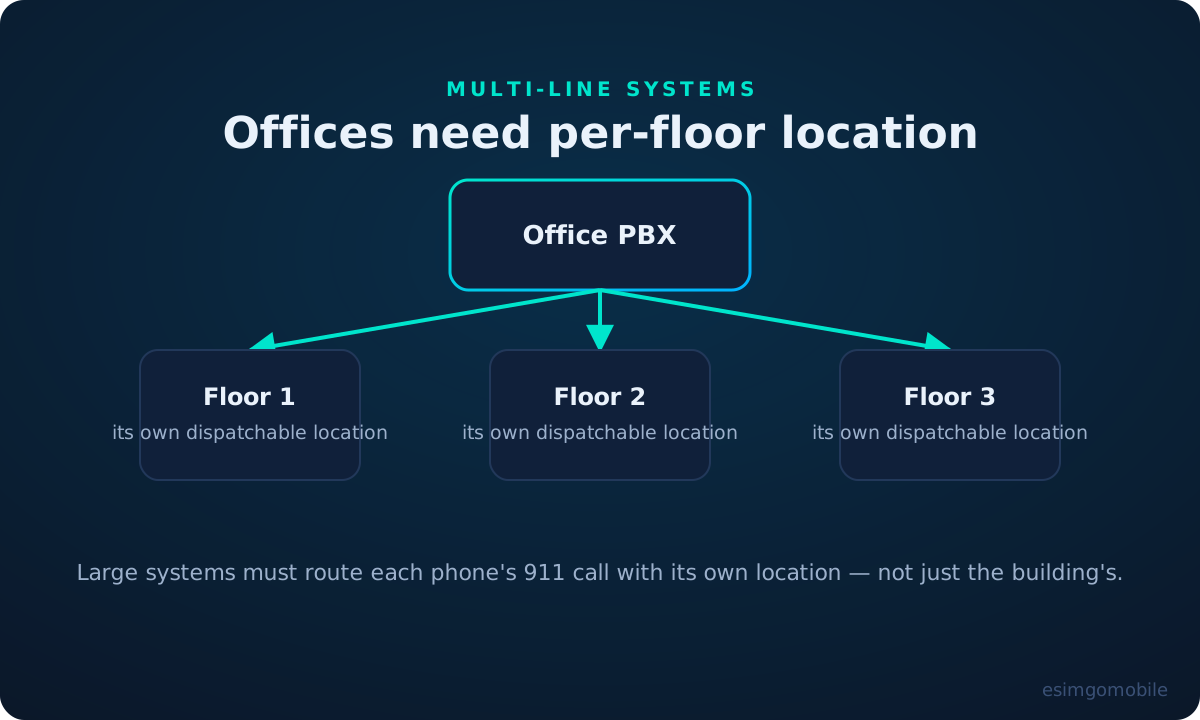
For businesses, this means the phone system needs location-aware configuration: phones or zones mapped to validated addresses, kept current as offices reorganize. It’s administrative work, but it’s the kind that matters exactly once — on the worst day.
The practical checklist.
Whether you’re an individual with a virtual number or running a company phone system:
- Register an E911 address for every VoIP/virtual number at signup — and validate it’s dispatchable (full street address plus unit/floor where relevant).
- Test 911 routing with your provider’s non-emergency test procedure — never dial 911 to “see if it works.” Providers offer test numbers or scheduled tests for exactly this.
- Update the address when you move — offices, remote-work stints, even extended travel with a fixed VoIP device.
- Confirm direct 911 dialing on office systems (no prefix required) and that on-site notification reaches whoever should get it.
- Brief your team: everyone using a company VoIP line should know the registered address may differ from where they physically are.
- Keep a backup: a mobile phone with native emergency calling remains the most robust emergency device — E911 makes VoIP safe, not primary.
esimgomobile and E911: emergency calling support — including registered-location management — is part of what we’re building for launch, because a phone number you can’t trust in an emergency isn’t a real phone number. Get started.
Questions, answered.
What is E911?
Can I dial 911 from a virtual number?
What’s the difference between 911, E911 and NG911?
What is Kari’s Law?
What is dispatchable location?
I work remotely with a VoIP softphone. What should I do?
Where to go next.
Get your virtual number today.
Virtual numbers are live now — claim yours alongside any eSIM plan.