Home›Blog›Advanced eSIM guides

Advanced eSIM guides

eSIM vs Roaming vs Local SIM

Three ways to get data abroad, each with devoted fans and real trade-offs. Carrier roaming is effortless and expensive. Local SIMs are cheap and inconvenient. Travel eSIMs promise the best of both — and mostly deliver, with caveats. This is the honest comparison: how each option actually works, what each costs you in money and hassle, and which wins for each kind of trip. No sponsored rankings, no affiliate logic — just the trade-offs.

Chapter 1

The three options, defined

Carrier roaming: you change nothing. Your home SIM connects to partner networks abroad and your carrier bills you — per day, per megabyte, or from a roaming allowance. Zero setup, maximum continuity: same number, same apps, same everything.

Local SIM: you buy a prepaid SIM on arrival (or at the airport) and physically swap it in. Local rates, local number, local hassle: finding a shop, showing ID (many countries require registration), and losing access to your home number while it's out.

Travel eSIM: you buy a data plan online before departure and install it as a second line via QR code. Your home line stays in place for calls and SMS; the eSIM carries data at near-local rates. It's the dual-SIM strategy from our playbook, productized.

Note what's being compared: roaming and local SIMs are single-line approaches (one line at a time), while the travel eSIM is natively a second line. That structural difference drives most of the comparison below.
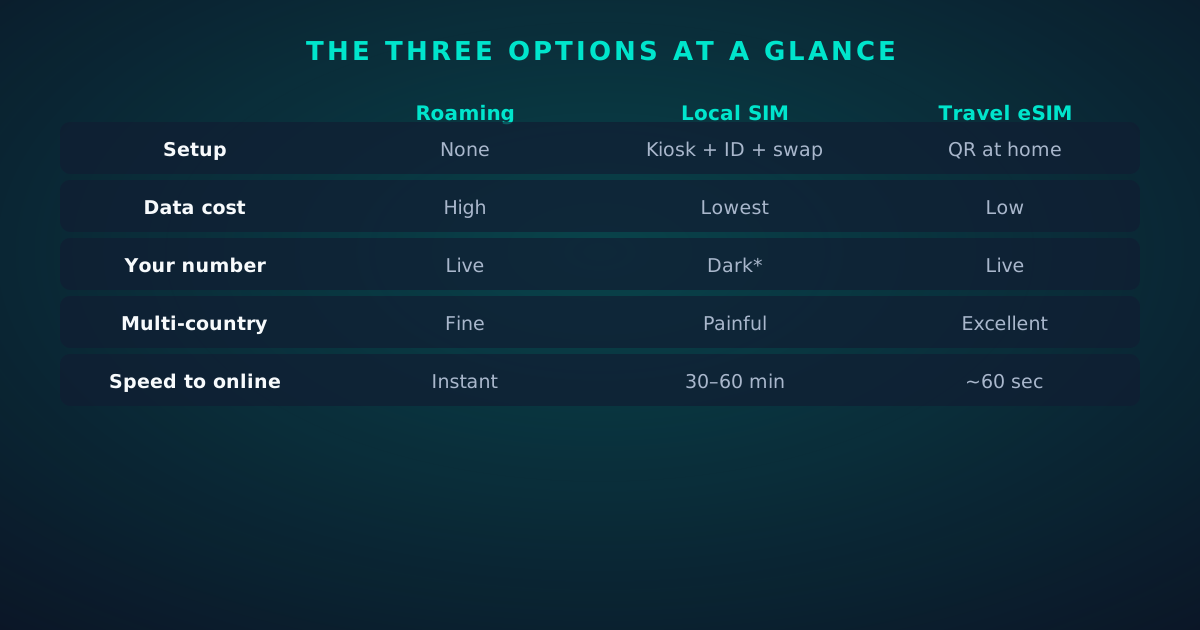
Comparison table: roaming versus local SIM versus travel eSIM across five dimensions
Chapter 2

Cost structure: what you're actually paying for

Forget specific prices — they vary wildly by home carrier and destination. What matters is the shape of each option's cost:

  • Roaming: priced for convenience. Daily passes look reasonable until a 14-day trip multiplies them; pay-per-MB pricing punishes background data you never consciously used. The cost driver is time abroad, not data used.
  • Local SIM: priced like a local. Generous data allowances at local market rates — the cheapest per gigabyte by far. The cost driver is data used, and the hidden costs are time (the kiosk queue) and the occasional tourist-markup SIM at the airport.
  • Travel eSIM: priced between the two — wholesale data rates plus the provider's margin, sold in fixed bundles. Cheaper than roaming by a wide margin, somewhat above street-price local SIMs. The cost driver is bundle size vs actual burn: buy too big and you overpay per gigabyte used.

For a week-long trip, roaming's daily fees often exceed a travel eSIM's entire bundle. For a month in one country, a local SIM usually wins on pure price — if you value your arrival hour at zero.
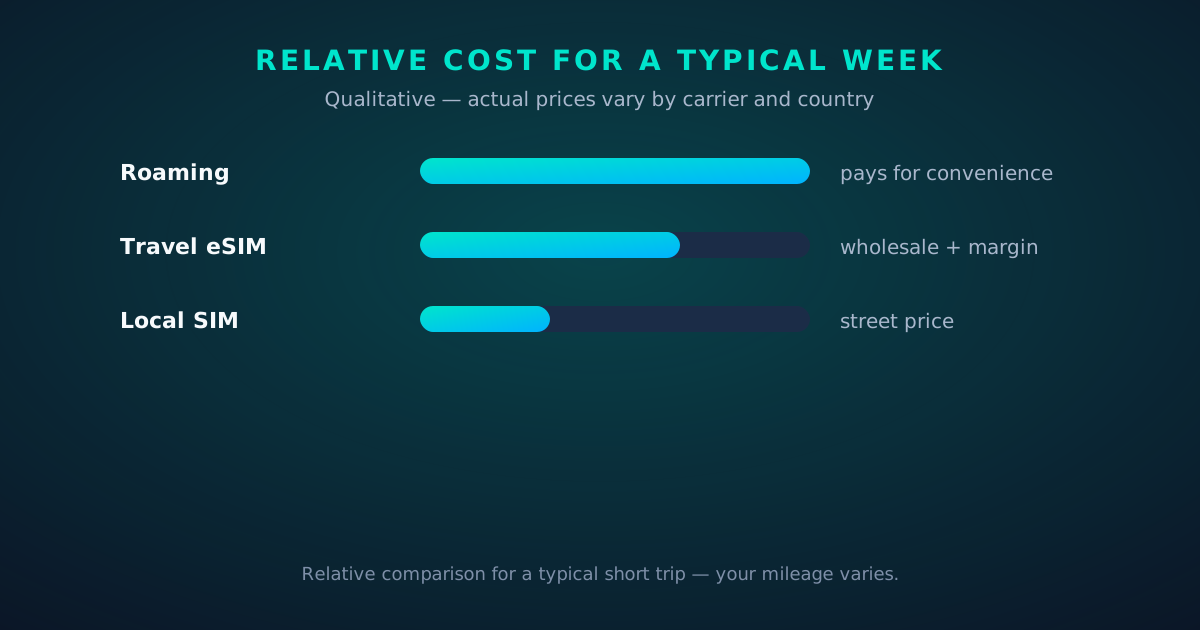
Qualitative bar chart comparing relative cost of roaming, travel eSIM and local SIM
Chapter 3

Convenience: the arrival test

Judge every option by the same moment: wheels down, phone in hand, needing a ride.

  • Roaming: already working. Score: perfect. You pay for this privilege.
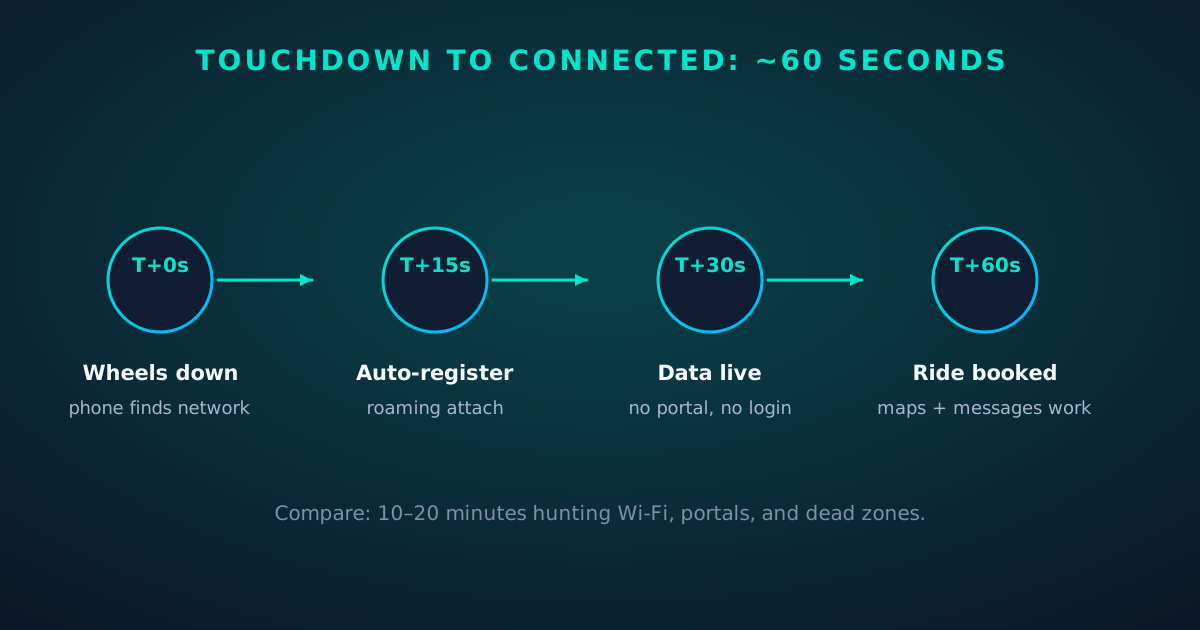
  • Travel eSIM: working in about 60 seconds — the profile was installed at home; the phone just registers. Score: nearly perfect, at a fraction of roaming's price.
  • Local SIM: not working. You're hunting a kiosk, queuing, showing your passport, waiting for activation, swapping the tiny plastic card with a paperclip, and hoping you don't lose your home SIM in the process. Score: miserable — and it repeats in every country.

Multi-country trips multiply the local-SIM pain linearly: new country, new kiosk, new number, new registration. The eSIM's regional plans were designed precisely for this itinerary.
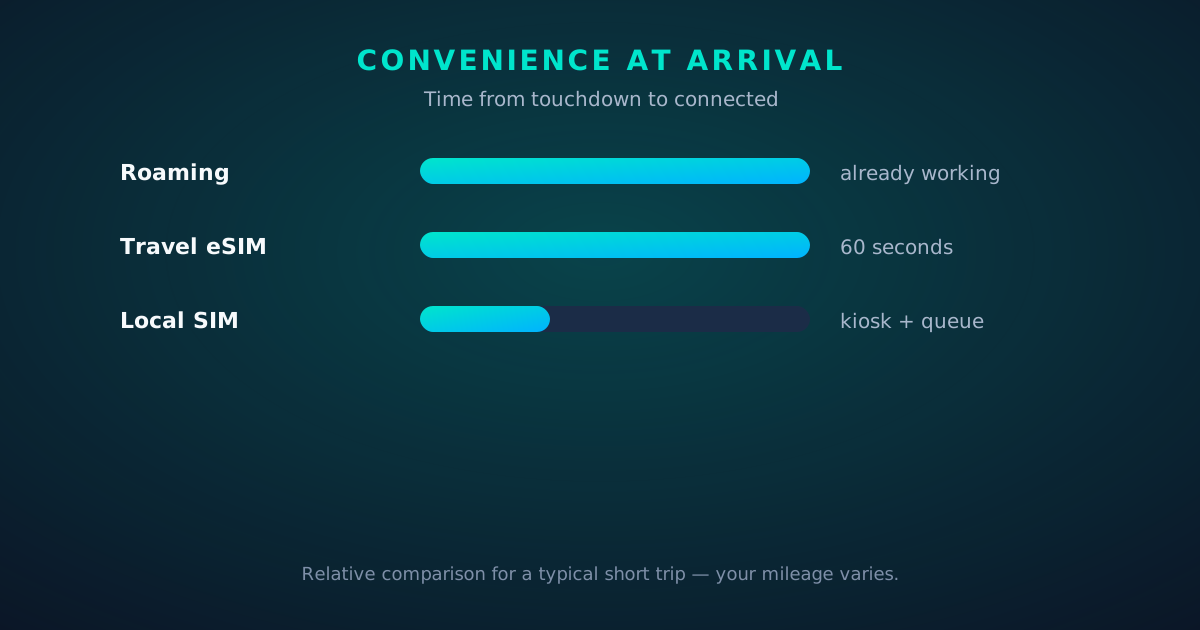
Qualitative bar chart comparing arrival convenience of the three options
Timeline: from touchdown to connected in about 60 seconds with an eSIM
Chapter 4

Number continuity: the hidden cost of local SIMs

This is the comparison's most underrated dimension. Your phone number isn't just for calls — it's your identity to banks, messaging apps and 2FA systems.

  • Roaming: your number works exactly as at home. Calls, SMS, bank codes — all uninterrupted.
  • Travel eSIM (dual-line): your number stays live on the home line alongside the eSIM. You get local-rate data plus full number continuity. This is the eSIM's killer feature, not the data price.
  • Local SIM: your home number goes dark the moment you swap the card out. Incoming calls fail, SMS codes vanish into the void, and WhatsApp may nag you about the number change. Dual-SIM phones mitigate this (keep the home SIM in slot 2), but single-SIM travelers face a real choice between cheap data and reachable identity.

If your trip involves any 2FA-gated bookings, banking or work logins, continuity isn't a nice-to-have — it's the whole game. Price the local SIM's "cheapness" against one missed bank code.

Chapter 5

Coverage and network quality

All three options ride on the same physical networks — the difference is which networks each option can access:

  • Roaming: your carrier's roaming agreements decide. Usually solid in popular destinations, sometimes limited to one partner per country.
  • Local SIM: you choose the carrier — pick the one with the best coverage where you're going. Maximum control, if you research.
  • Travel eSIM: the provider's partner networks decide. Good providers multi-home across several partners per country; weaker ones single-home. If performance disappoints, manually selecting a different partner network often fixes it.

In practice, all three are "fine" in cities and differ most in rural coverage and congestion handling. eSIM providers that publish their partner networks let you compare honestly — prefer those.

Chapter 6

Security notes

Short version: the connection type matters less than your habits, but there are real differences.

  • Roaming and eSIM both use carrier-grade cellular encryption on the radio link. Equivalent.
  • Local SIMs require handing your passport to a street kiosk and are tied to local identity-registration databases — a privacy trade many travelers accept without thinking.
  • eSIM installation happens over authenticated provisioning (see our security guide) — no ID photocopies at kiosks, no physical card to lose.
  • None of the three protects you from phishing, malicious apps or unencrypted websites. The padlock icon matters more than the SIM type.
Chapter 7

Which wins for your trip

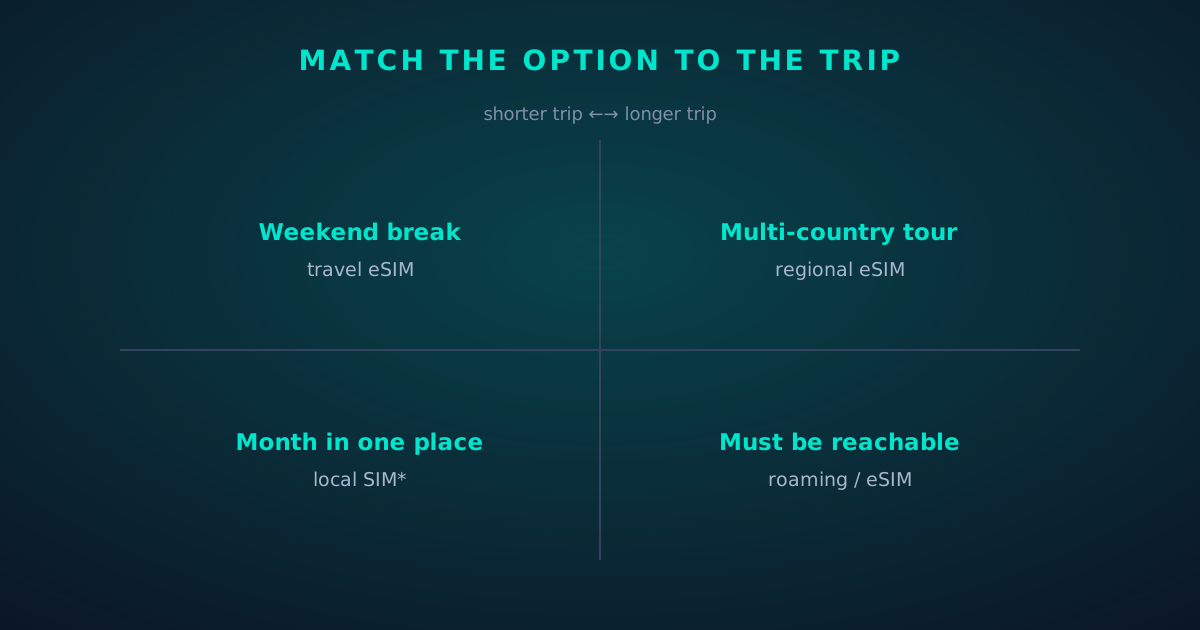
Match the option to the itinerary:

  • Weekend city break, one country: travel eSIM. Sixty-second setup, no kiosk, number intact.
  • Two-week multi-country tour: travel eSIM, regional plan. This is the itinerary the product was born for.
  • Month+ in one country: local SIM wins on price — if you have a dual-SIM phone to keep your home number live. Single-SIM phone? The eSIM's continuity is worth the premium.
  • Business trip where you must be reachable: roaming or eSIM. Never gamble reachability on a kiosk queue.
  • Off-grid / rural: local SIM from the carrier with the best rural coverage — researched in advance, not bought at the airport.
  • Traveling for work on a laptop: eSIM with confirmed tethering, sized for laptop burn rates. Hotel Wi-Fi as supplement, not plan A.
Decision matrix matching trip types to the best connectivity option
Chapter 8

The hybrid answer

The sophisticated move is refusing to choose. Combinations beat any single option:

  • eSIM + roaming as backup: travel eSIM for data, home line with roaming enabled for voice/SMS only (data roaming off). Cheap data, full continuity — the dual-line playbook.
  • eSIM + local SIM: eSIM for the multi-country legs, a local SIM for the long single-country stay — in a dual-SIM phone, all three lines coexist.
  • Two eSIM providers: primary plus backup from different providers. Provider-level redundancy for the price of a coffee.

The through-line: eSIM isn't just a cheaper roaming — it's the technology that lets you combine options instead of picking one. That's the real upgrade.
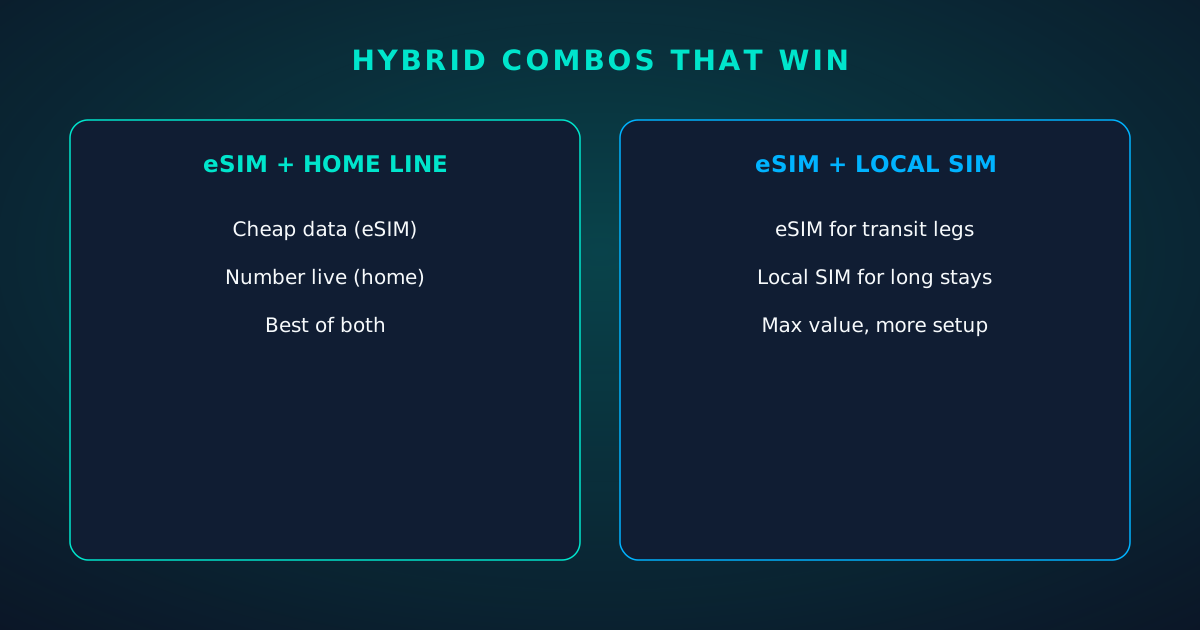
Split panel: winning hybrid combinations of eSIM with roaming or local SIM
FAQ

Questions travelers actually ask.

Is a travel eSIM always cheaper than roaming?
Almost always for data-heavy use — roaming is priced for convenience (daily fees or per-MB rates) while eSIMs sell wholesale data in bundles. The exception is carriers that include generous roaming in the base plan; check yours before assuming.
Is a local SIM cheaper than a travel eSIM?
Usually yes per gigabyte, since you pay local street prices. The trade-off is the kiosk queue, ID registration, losing your home number (on single-SIM phones), and repeating the whole ritual per country.
Can I keep my number with a local SIM?
Only on a dual-SIM phone, keeping your home SIM in the second slot. On a single-SIM phone, swapping the card out takes your number offline — calls fail and SMS codes go nowhere.
Do travel eSIMs work for calls and texts?
Most are data-only — no number, no cellular voice. You call and text over data (WhatsApp, FaceTime, VoIP). Some plans include a number; check before you buy if you need one.
Which is best for a multi-country trip?
A regional travel eSIM: one installation, automatic network changes at each border, your home number live throughout. Local SIMs scale terribly across borders; roaming scales terribly on price.
Can I combine eSIM with my home plan?
That's the recommended setup: home line registered for calls/SMS with data roaming off, travel eSIM as the data line. See our dual-eSIM playbook for the exact settings.
Keep going

Your next read.

📱

The Dual-eSIM Travel Playbook

Run home + travel lines together.

Read next
🗺️

Regional vs Global eSIM Plans

Footprints for multi-country trips.

Read next
✈️

Beyond Airport Wi-Fi

Why landing connected beats the kiosk.

Read next

The experience

From the article to your phone.

Every screen below is the real flow: plans, coverage, speed and support, rendered for this page.

esimgomobile.com
Plans for eSIM vs Roaming vs Local SIM
Atlas 5GB5 GB · 30 days
Atlas 20GB20 GB · 30 days
Atlas 50GB50 GB · 60 days
Compare plans
Plan picker on eSIM vs Roaming vs Local SIM Compared: 5GB, 20GB, 50GB and Unlimited — pick by trip, not fine print.
  1. 1Checkout shows the full price before you pay. Nothing hidden.
  2. 2Amazon Pay handles payment securely; taxes are calculated for you.
eSIM vs Roaming vs Local SIM · 5G
Signal widget on eSIM vs Roaming vs Local SIM Compared: network generation and place, always visible.
  1. 1Usage ring compresses the whole plan into one glanceable number.
  2. 2Percent remaining is the only metric most travelers check.
Speed test
340Mbps
5G · eSIM vs Roaming vs Local SIM · 40 ms
Illustrative speed readout on eSIM vs Roaming vs Local SIM Compared: 340 Mbps, 40 ms — example figures, not live measurements.
  1. 1The Tele Agent answers in plain language — no telecom jargon.
  2. 2Every answer is specific to your trip, not a generic FAQ.
Atlas 20GB
20 GB · 30 days
eSIM vs Roaming vs Local SIM
Atlas 20GB — 20 GB · 30 days, prepaid and ready on eSIM vs Roaming vs Local SIM Compared.
  1. 1Usage ring compresses the whole plan into one glanceable number.
  2. 2Percent remaining is the only metric most travelers check.
esimgomobile.com
API quickstart
curl https://api.esimgomobile.com/v1/esims \
  -H "Authorization: Bearer $KEY" \
  -d '{"country":"ES"}'


200 OK · 148 ms
REST API behind eSIM vs Roaming vs Local SIM Compared: issue eSIMs programmatically — 200 OK in milliseconds.
  1. 1The dashboard keeps every eSIM, every trip, in one place.
  2. 2Rows show data left, days left and current city at a glance.
man in black jacket standing on rock formation under blue sky
Get connected
1 Pick a plan2 Scan QR3 Land online
Three steps on eSIM vs Roaming vs Local SIM Compared: pick a plan, scan the QR, land online.
  1. 1Coverage status at a glance: data live, number available, 5G ready.
  2. 2Green means go — no guessing about what's supported.
Recent speeds
Sydney407 Mbps
Sydney610 Mbps
Paris362 Mbps
Recent speeds for eSIM vs Roaming vs Local SIM Compared — Sydney, Sydney, Paris: illustrative 5G figures, not live measurements.
  1. 1Mockups illustrate the product flow — captions describe what's real.
  2. 2Figures labeled as examples show sample data, never live telemetry.
eSIM plan
Atlas 5GB5 GB · 30 days
eSIM vs Roaming vs Local SIM
Install eSIM
Atlas 5GB on eSIM vs Roaming vs Local SIM Compared — 5 GB · 30 days, prepaid with the full price shown before you pay.
  1. 1Live usage ring: see remaining data at a glance, no mental math.
  2. 2Top-up button sits right where you need it when data runs low.
Coverage
195
destinations live
eSIM vs Roaming vs Local SIM5G ready
Check coverage
Coverage at a glance for eSIM vs Roaming vs Local SIM Compared: 195 destinations live, fastest local partner selected on its own.
  1. 1Illustrative speed readout: sample carrier, city and latency figures.
  2. 2The meter demonstrates the readout — figures are examples, not live measurements.
Tele Agent
“Setting up your eSIM vs Roaming vs Local SIM line…”
AI voice agent on eSIM vs Roaming vs Local SIM Compared — answers spoken aloud, never a support ticket.
  1. 1Live usage ring: see remaining data at a glance, no mental math.
  2. 2Top-up button sits right where you need it when data runs low.
new york city buildings
Pack light. Stay connected on your trip.
Get your eSIM
Live now · no waitlist
“Pack light. Stay connected on your trip.” — the CTA card on eSIM vs Roaming vs Local SIM Compared: plans live now, no waitlist.
  1. 1A real traveler quote, tied to the destination it mentions.
  2. 2Reviews reference actual trips, not generic praise.
My eSIM
41%10 GB left
Days left17
Top up+10 GB
Data dashboard on eSIM vs Roaming vs Local SIM Compared: 41% remaining, days left, top-up one tap away.
  1. 1The Tele Agent answers in plain language — no telecom jargon.
  2. 2Every answer is specific to your trip, not a generic FAQ.
esimgomobile.com
Dashboard
Active eSIMs4
Data left50 GB
Current cityeSIM vs Roaming vs Local SIM
Web dashboard on eSIM vs Roaming vs Local SIM Compared: every eSIM, every trip, 50 GB left — one screen.
  1. 1Three plans side by side so the trade-off is obvious.
  2. 2Pick by trip length, not by decoding fine print.
a group of people having a discussion
Pack light. Stay connected on your trip.
Get your eSIM
“Pack light. Stay connected on your trip.” — the banner on eSIM vs Roaming vs Local SIM Compared: two minutes from curious to connected.
  1. 1Mockups illustrate the product flow — captions describe what's real.
  2. 2Figures labeled as examples show sample data, never live telemetry.
Install
1 Scan2 Add3 Go
The eSIM vs Roaming vs Local SIM Compared install: QR in three steps — scan, add, go, about two minutes.
  1. 1The Tele Agent answers in plain language — no telecom jargon.
  2. 2Every answer is specific to your trip, not a generic FAQ.
Virtual number
+1 205 753 8456
Routes toeSIM vs Roaming vs Local SIM
SMS + voiceEnabled
Your second line on eSIM vs Roaming vs Local SIM Compared: +1 205 753 8456 — real number, SMS and voice enabled.
  1. 1Coverage status at a glance: data live, number available, 5G ready.
  2. 2Green means go — no guessing about what's supported.
Network
5G
eSIM vs Roaming vs Local SIM connected
Network widget for eSIM vs Roaming vs Local SIM Compared: 5G, full bars — zero ambiguity about the connection.
  1. 1The plan card shows exactly what you're buying — data, days, destination.
  2. 2One tap starts the two-minute QR install.
vs roaming
esimgomobile eSIMone price
Carrier roamingper-day fees
10 GB · 14 days · eSIM vs Roaming vs Local SIM
The honest comparison on eSIM vs Roaming vs Local SIM Compared: one prepaid eSIM price versus carrier roaming.
  1. 1The roaming math, made visible: one price versus per-day carrier fees.
  2. 2This is the comparison most travelers never see until the bill.
74%
data left
Usage ring on eSIM vs Roaming vs Local SIM Compared — 74% of data left: the number travelers check most.
  1. 1Signal widget: network generation and destination, always visible.
  2. 2Five bars, zero ambiguity about what you're connected to.
Support
How does eSIM vs Roaming vs Local SIM Compared work?
Enter your trip details and get an instant answer — no account needed.
Support snippet — eSIM vs Roaming vs Local SIM Compared: what it does, in one honest answer.
  1. 1The roaming math, made visible: one price versus per-day carrier fees.
  2. 2This is the comparison most travelers never see until the bill.
silver macbook on wooden table beside a paper cup — Family group chat: location shared, dinner plans settled in minutes.
Family group chat: location shared, dinner plans settled in minutes.
Tomáš Malík — Downtown, connected: the eSIM finds the fastest local network on its own.
Downtown, connected: the eSIM finds the fastest local network on its own.
four people wearing headphones — The conference badge: QR ticket scanned, session schedule synced.
The conference badge: QR ticket scanned, session schedule synced.
A couple enjoying a sunny day with smartphones and wine glasses on a rooftop in Portugal. — Golden hour, fully online — photo backups upload before dinner.
Golden hour, fully online — photo backups upload before dinner.
Erik Mclean — Hiking the ridge: trail map offline, emergency numbers saved.
Hiking the ridge: trail map offline, emergency numbers saved.
airplane wing and thick clouds — Café office: hotspot running, video call stable, no hotel Wi-Fi roulette.
Café office: hotspot running, video call stable, no hotel Wi-Fi roulette.
eifel tower from the port liena — Island time, online time: ferries, beaches and full signal.
Island time, online time: ferries, beaches and full signal.
stone bridge over river in megalopolis — The group chat stays live across every border you cross.
The group chat stays live across every border you cross.
Sahir Sujahudeen — The food tour: every recommendation looked up on the spot.
The food tour: every recommendation looked up on the spot.
black headset with mouthpiece — Currency exchange, skipped: the phone pays at the real rate.
Currency exchange, skipped: the phone pays at the real rate.
woman working on laptop in outdoor cafe setting — The welcome home: eSIM deleted in one tap, no contract to cancel.
The welcome home: eSIM deleted in one tap, no contract to cancel.
A hand holding a smartphone capturing a bustling train station with blurred travelers in the background. — Border crossings without the paperwork shuffle: ID photos stored on the phone.
Border crossings without the paperwork shuffle: ID photos stored on the phone.
an elderly man on video call with an agent doing a hand sign — Street level: navigation, rideshares and reviews, all instant.
Street level: navigation, rideshares and reviews, all instant.
top view of people writing on papers — Real journeys, real connectivity — this is what the product is for.
Real journeys, real connectivity — this is what the product is for.
AMITR MEENA (AMMY) — The connected trip: maps, messages and translation, all on one eSIM.
The connected trip: maps, messages and translation, all on one eSIM.
Man in orange shirt using a smartphone while standing at an airport window, overlooking the runway. — The rental desk handshake: confirmation email open, license photo ready.
The rental desk handshake: confirmation email open, license photo ready.
a blue wooden door on a white concrete wall — The modern arrival: online before the seatbelt sign goes off.
The modern arrival: online before the seatbelt sign goes off.
people having a toast — The red-eye recovery: hotel early-check-in arranged mid-flight.
The red-eye recovery: hotel early-check-in arranged mid-flight.
Saila Holidays Zanzibar — Check-in lines move faster when your documents are on your phone.
Check-in lines move faster when your documents are on your phone.
cute little girl with suitcase and passport — The night bus: entertainment downloaded, messages queued, rest easy.
The night bus: entertainment downloaded, messages queued, rest easy.

Explainer

Key takeaways

  • When something goes wrong abroad, the fix is almost always: toggle airplane mode, check the eSIM line is enabled, then ask the Tele Agent.
  • The core idea: eSIM vs Roaming vs Local SIM Compared matters because connectivity shapes the whole trip, not just the phone bill.
  • Setup beats improvisation — every tip in this article works best arranged before departure.
  • Match the plan to the trip length and your heaviest single use-case, then stop thinking about it.
  • Data-first eSIMs keep your number and your apps; the only thing that changes is the price.

Explainer

Putting it into practice

Install the eSIM now — it costs nothing to have it sitting on your phone waiting. Activation happens when you say so.

Reading about eSIM vs Roaming vs Local SIM Compared is step zero. Step one is a two-minute action: check your phone is unlocked and eSIM-capable, then pick a plan sized to your next trip.

Then run through the travel tips checklist above. Ten minutes of preparation saves hours of airport problem-solving.

Go deeper

And the Tele Agent will walk through any of this conversationally if you'd rather talk than read.

The tools index turns article advice into instant answers — coverage checks, plan pickers and compatibility checks that take seconds.

Explainer

Common mistakes to avoid

  • Assuming hotel Wi-Fi will do: it won't, at the exact moment you need it most.
  • Buying data at the airport: the most expensive megabyte is the panicked one.
  • Ignoring the 80% alert: top up early; data never gets cheaper mid-trip.
  • Disabling the wrong line: label your eSIM clearly in phone settings.
  • Forgetting two-factor: banks text your home number — keep that SIM active.

By the numbers

The numbers behind eSIM vs Roaming vs Local SIM Compared.

eSIM vs Roaming vs Local SIM Compared — data dashboard

The numbers behind the story, switchable by dataset.

3
steps to connect
pick, scan, land
195
destinations
one eSIM
~2 min
install time
QR code
24/7
support
human + AI
Maps & navigation: ≈5 MB/hourMaps & nav ≈200 h / GBMessaging & email: ≈20 MB/hourMessaging ≈50 h / GBSocial browsing: ≈150 MB/hourSocial ≈6.7 h / GBVideo calls: ≈600 MB/hourVideo calls ≈1.7 h / GBHD streaming: ≈1.5 GB/hourStreaming ≈40 min / GB
Atlas 5GB: 5 GB — Weekend breaks & light useAtlas 5GB 5 GBAtlas 20GB: 20 GB — Two-week trips & daily useAtlas 20GB 20 GBAtlas 50GB: 50 GB — Remote work & hotspottingAtlas 50GB 50 GBAtlas Unlimited: Unlimited — Heavy use, zero meteringAtlas Unlimited Unlimited
Illustrative — Wk 1: 90% of maxIllustrative — Wk 2: 62% of maxIllustrative — Wk 3: 38% of maxIllustrative — Wk 4: 15% of maxWeek 1Week 2Week 3Week 4IllustrativeIllustrative 20 GB burn-down at moderate use — your mileage varies.

Hover any bar or point for its exact value. Tabs switch datasets — everything on this panel is computed from live product data unless labeled illustrative.

eSIM vs Roaming vs Local SIM Compared — data dashboard. Usage rates, plan sizes and a typical burn-down curve — the numbers behind “eSIM vs Roaming vs Local SIM Compared”.
Questions, answeredThe six things everyone asks firstQuestions, answeredShort answers, no sales pitch.What if data runs out?
80% alert, then one-tap top-up. No bill shock.
Which phones work?
Any carrier-unlocked, eSIM-capable iPhone or Android.
How fast is setup?
About two minutes: plan, QR scan, done.
Does hotspot work?
Yes — share your connection with laptop or tablet.
Is it a contract?
No — prepaid. Service simply stops instead of charging extra.
Do I keep my number?
Yes — WhatsApp & iMessage keep working on your existing number.
FAQ at a glance. Still curious? The Tele Agent answers anything else instantly.
Every plan includesNo tiers of basic dignity — these ship with all plansEvery plan includesThe baseline is generous on purpose.6 languagesThe app speaks your language, wherever you're from.5G where availableFastest local partner network, selected automatically.24/7 supportReal humans plus the Tele Agent, around the clock.One-tap top-upMore data in seconds — no new QR code.Hotspot includedShare with your laptop or tablet at no extra cost.Keep your WhatsAppYour existing number keeps working on the data line.
Included with every plan. Six things ship with every plan — the eSIM vs Roaming vs Local SIM Compared baseline, generous on purpose.
TakeawaysIf you remember nothing else, remember thisTakeawaysThe article in four sentences.Prepaid = calmNo contracts means no surprise charges, ever.Install earlyBuy before you fly — setup takes two minutes, not two hours.eSIM firstFor most trips, a prepaid eSIM beats roaming on price and convenience.Size it right5 GB weekends, 20 GB fortnights, 50 GB+ for work trips.
Takeaways. Four sentences carrying the whole of eSIM vs Roaming vs Local SIM Compared.
Your action planTurn reading into doingYour action planFour moves from this page to connected.1Check your phoneCarrier-unlocked and eSIM-capable? You're good to go.2Pick a planMatch gigabytes to trip length — the matrix above helps.3Install the eSIMScan the QR code. Two minutes, done.4Land connectedSwitch the line on at arrival and go.
Action plan. From reading eSIM vs Roaming vs Local SIM Compared to landing connected.
What your gigabytes meanTypical hourly usage per activityWhat your gigabytes meanTranslate plan sizes into real travel behavior.Maps & navigation≈ 5 MB / hourMessaging & email≈ 20 MB / hourSocial browsing≈ 150 MB / hourVideo calls≈ 600 MB / hourHD streaming≈ 1.5 GB / hourTypical usage rates — actual consumption varies by app and quality settings.
Data usage guide. A 20 GB plan covers roughly two weeks of normal travel use.
eSIM vs Roaming vs Local SIM Compared: key numbersThe figures behind the storyKey numbersThe figures this guide keeps coming back to.3steps to get connectedesimgomobile network data195destinations coveredesimgomobile network data2 minto install an eSIMesimgomobile network data24/7support, human + AIesimgomobile network dataNumbers from the esimgomobile network — verified, not vibes.
Key numbers. Key numbers first — the article's load-bearing facts.
Get connected in three stepsFrom purchase to online in about two minutesGet connected in three stepsNo store visit, no plastic SIM, no waiting for the post.1Land connectedSwitch the line on when you arrive — online before baggage claim.2Pick your planChoose data for your trip — checkout takes about two minutes.3Scan the QR codeThe eSIM installs straight onto your phone. No store, no plastic SIM.
Three-step setup. Buy, scan, land: the whole sequence fits in a coffee queue.
Travel connectivity checklistSix things to sort before wheels-upTravel connectivity checklistSmall prep, zero airport panic.Screenshot bookingsHotel address & confirmations, available with no signal.Download offline mapsThey save data and work in dead zones.Set an 80% alertA top-up should never surprise you mid-trip.Keep home SIM for 2FABank codes still arrive while data runs on the eSIM.Install before you flyAirport Wi-Fi is the worst place to set up connectivity.Check unlock statusCarrier-locked phones can't add an eSIM — verify first.
Pre-flight checklist. Small prep now, zero airport panic later.
Pro tipsFour habits of the always-connectedPro tipsSmall habits, big difference.1Download offline mapsThey save data and work in dead zones.2Keep home SIM for 2FABank codes still arrive while data runs on the eSIM.3Set an 80% alertA top-up should never surprise you mid-trip.4Install before you flyAirport Wi-Fi is the worst place to set up connectivity.
Pro tips. Veterans do all four without thinking.
Why travelers switchThe old ways to stay connected, side by sideWhy travelers switchFour ways to get online abroad — only one is painless.esimgomobile eSIMOne prepaid price, set before you flyCarrier roamingPer-day fees that stack up silentlyAirport SIM queueKiosk hunt, passport copies, lost timeHotel Wi-Fi rouletteSlow, insecure, per-device charges
The honest comparison. One prepaid price versus per-day fees: the math, made visible.

Take us with you, connected

Prepaid, no contracts, no roaming surprises. The whole setup takes about two minutes.

See plans and pricing Talk to the Tele Agent