What porting actually is.
Porting moves your phone number from one provider to another without changing the digits. The number stays the same; only the company hosting it changes. It’s the reason you can leave a carrier you hate without reprinting every business card you own — and in most countries, it’s a regulated right, not a favor your provider does you.
Underneath, porting is a database update. The world’s phone networks consult number-portability databases to find which carrier currently hosts a number; porting rewrites that entry to point at your new provider. Calls in flight during the cutover take the old path, calls after take the new one — the “porting window” is the brief moment both are true, which is why ports are scheduled, not instantaneous.
The golden rule of porting: do not cancel your old service before the port completes. Canceling releases the number, and a released number can be lost. The port itself closes the old account — let it.
The timeline.
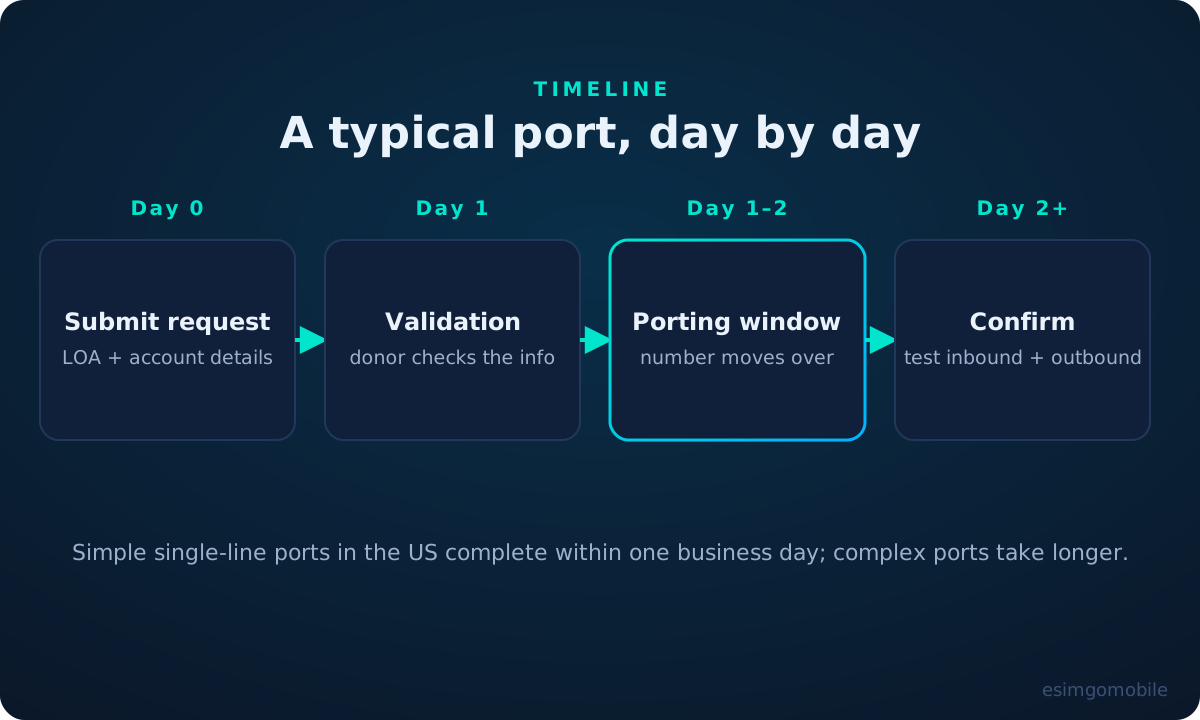
In the US, FCC rules require simple ports — a single line with no complicating features — to complete within one business day. That’s the regulatory floor for the common case, and most straightforward ports hit it. Complex ports (multi-line accounts, toll-free numbers, PBX ranges) run on longer, negotiated timelines: days to weeks, with a scheduled cutover you plan around.
The three players.
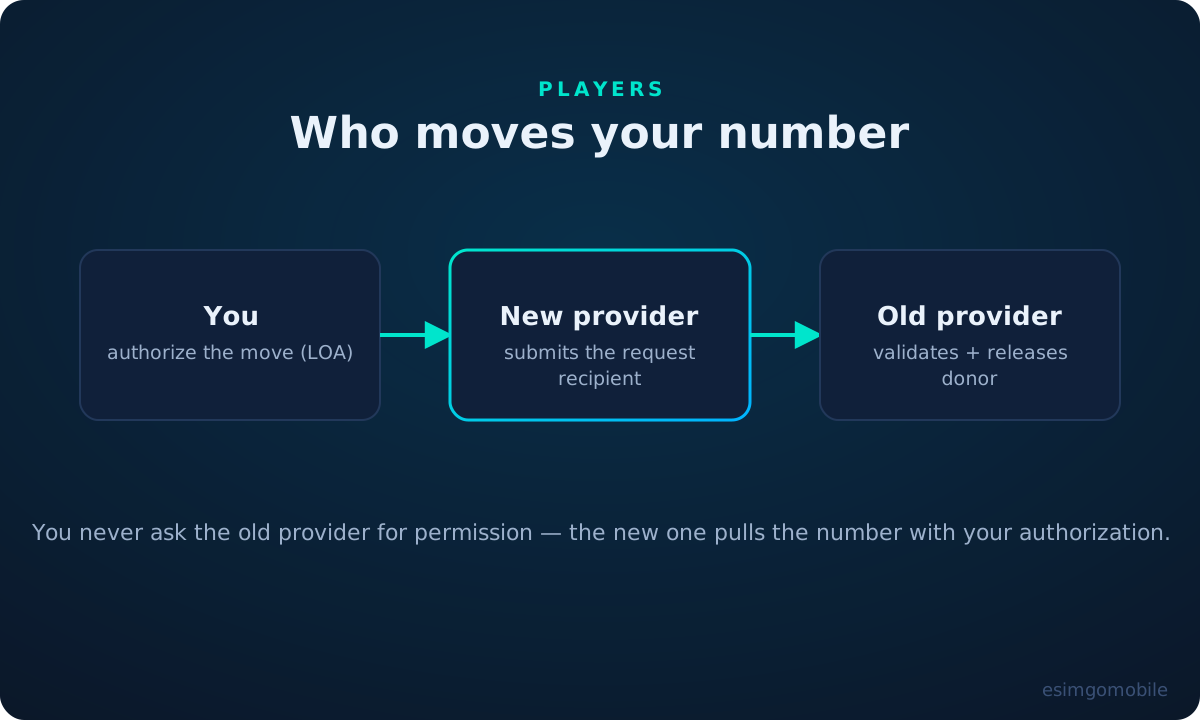
Note the counterintuitive part: you never ask the old provider for permission. You authorize the new provider with a Letter of Authorization, and they request the number from the old one. The old provider’s job is to validate the request against their records and release the number — they can’t refuse a valid port to keep you as a customer. (They may try to win you back with a retention call. That’s marketing, not procedure.)
Simple vs. complex ports.
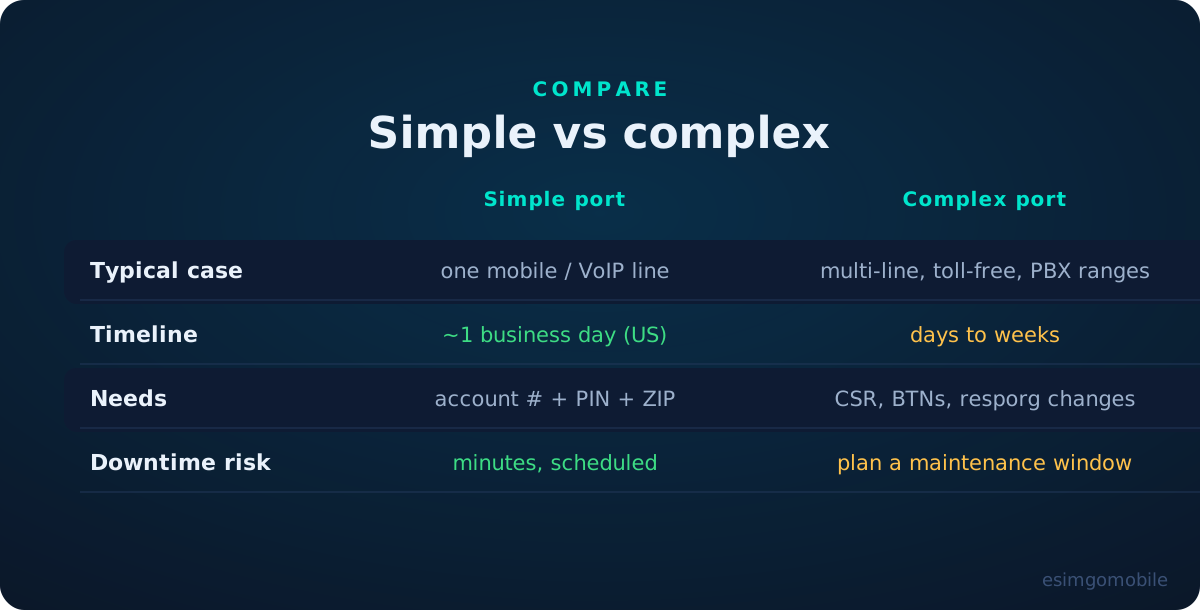
What pushes a port into “complex” territory: multiple lines on one account, hunt groups and PBX configurations, toll-free numbers (which move via a separate RespOrg process in North America), and numbers tied to special services. Complex doesn’t mean hard — it means coordinated: more records to match, more parties to align, and a cutover window worth scheduling outside business hours.
The LOA checklist: get the details exactly right.
The Letter of Authorization is your signed permission for the new provider to take the number. But the LOA is rarely what fails — what fails is the matching: the old provider compares every field against their Customer Service Record, and anything that doesn’t match bounces the request.
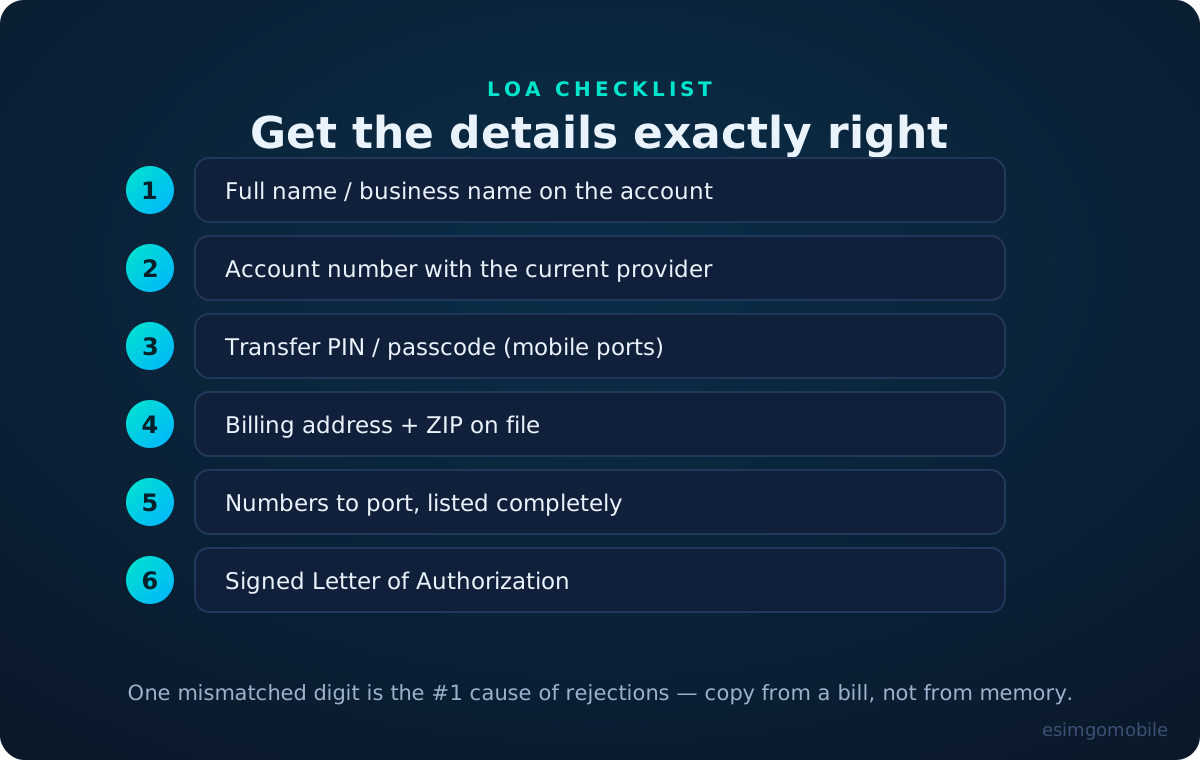
The transfer PIN deserves a callout: US wireless carriers now require a Number Transfer PIN (generated in the carrier’s app or by customer service) specifically to prevent unauthorized ports — a fraud protection that doubles as the most common missing item. Generate it fresh; they expire.
Copy, don’t recall. The #1 porting failure worldwide is a detail misremembered: a middle initial on the account, an old ZIP, the account number vs. the phone number. Open a recent bill and transcribe. It takes five minutes and prevents a week of back-and-forth.
Rejections → fixes.
When a port bounces, the old provider returns a reason code. Here are the classics and what to do about each:
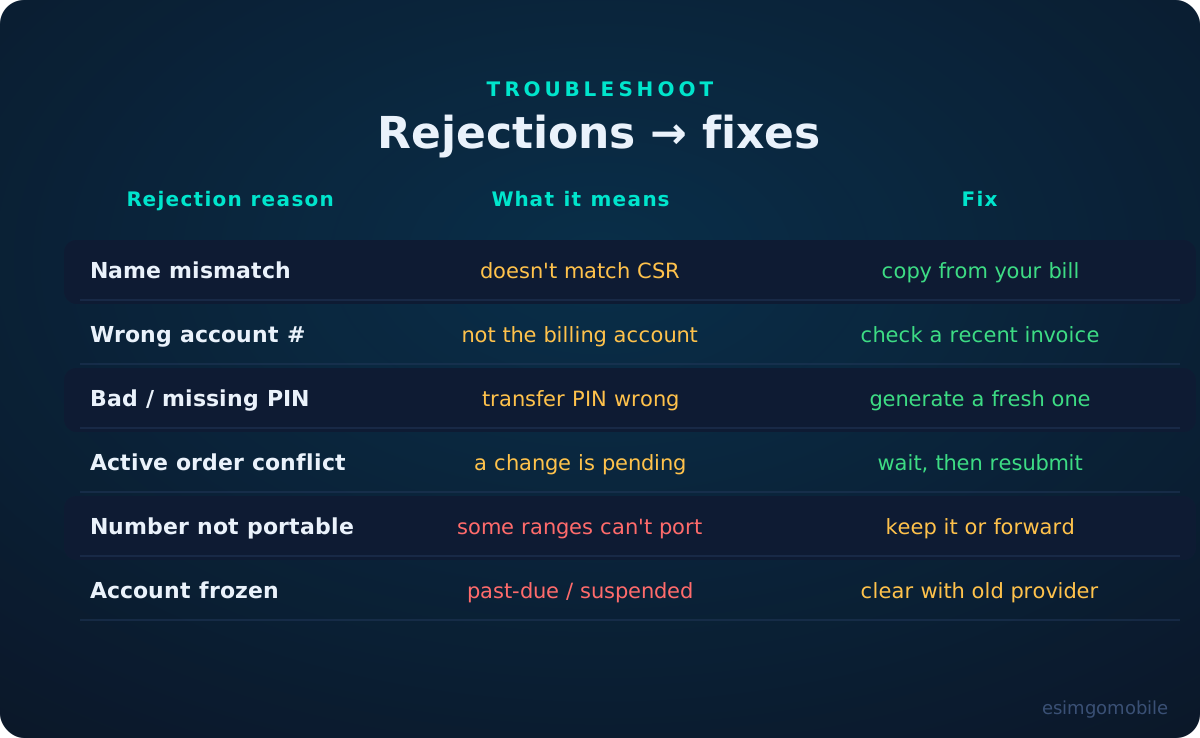
One more subtle trap: pending orders. If there’s an open service change on the old account — a plan change, an address update, anything in flight — the port can’t proceed until it clears. If your port stalls mysteriously, ask the old provider: “is there an open order on my account?”
Porting away: leaving is your right.
Porting works in both directions, and that symmetry is the point. A provider that makes leaving hard — obscure processes, “retention specialists” as gatekeepers, mysterious “technical limitations” — is telling you everything about what staying will be like. Healthy providers treat port-outs as routine: validate, release, wish you well.
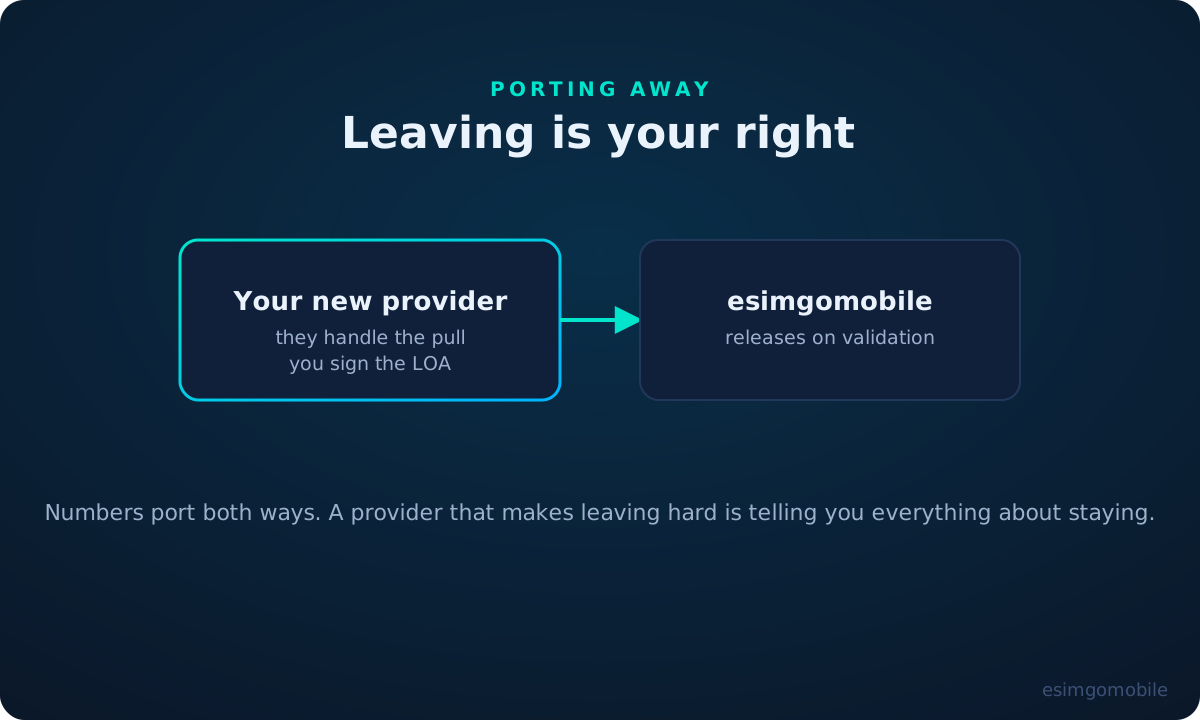
Before you port away anywhere: check for contract terms (early termination fees are a billing matter, not a porting block — they can’t hold your number hostage for an unpaid device installment, though settling up is wise), download any records you need, and time the port so the new service is confirmed working before you need it.
What can’t be ported.
Honesty requires the exceptions:
- Disconnected numbers — once released back to the pool, a number is generally gone. Port while the service is active.
- Some special ranges — certain premium, short-code, or carrier-internal numbers were never portable. Ask before assuming.
- Across incompatible types — a mobile number usually can’t become a toll-free number and vice versa; the numbering plan has rules.
- Across borders — porting is national. A US number can’t port to a UK provider; numbering plans are per-country.
- Numbers you don’t own — employer-issued or shared numbers need the account holder’s authorization.
When a number truly can’t port, the fallback is forwarding: keep the old number alive on a cheap plan (or with the old provider) and forward it to the new one indefinitely. Not elegant, but it preserves every printed instance of the number while the new identity takes over.
Porting to esimgomobile: number porting in both directions is part of the launch plan — bring the number customers already know, or take yours with you if you ever leave. Get started to be notified.
Questions, answered.
How long does porting take?
Will I lose service during the port?
Should I cancel my old service first?
What is a Number Transfer PIN?
Why was my port rejected?
Can I port a toll-free number?
Can I port my number to another country?
Where to go next.
Get your virtual number today.
Virtual numbers are live now — claim yours alongside any eSIM plan.