Blog · Travel guides
Asia on one eSIM: the complete travel guide.
Japan to Singapore on one profile: the Asia eSIM travel guide — regional plans, country-list checks, validity planning, dual-SIM strategy and field-tested tips for multi-country loops.
Why Asia rewards a little more planning
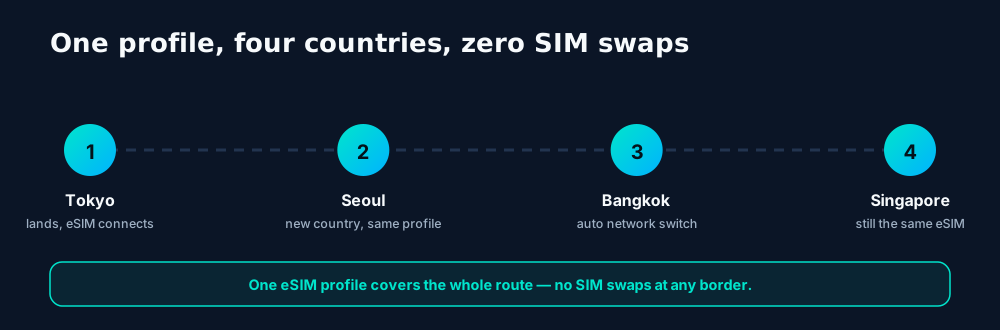
Asia is where travel eSIMs quietly do their hardest work. Europe gives you open borders and one regulatory zone; Asia gives you a dozen countries, a dozen registration regimes, and itineraries that hop from Tokyo's neon to Thai islands in a single fortnight. The strategy is the same — one regional profile, installed before departure — but the planning repays a little more attention.
What varies, country to country
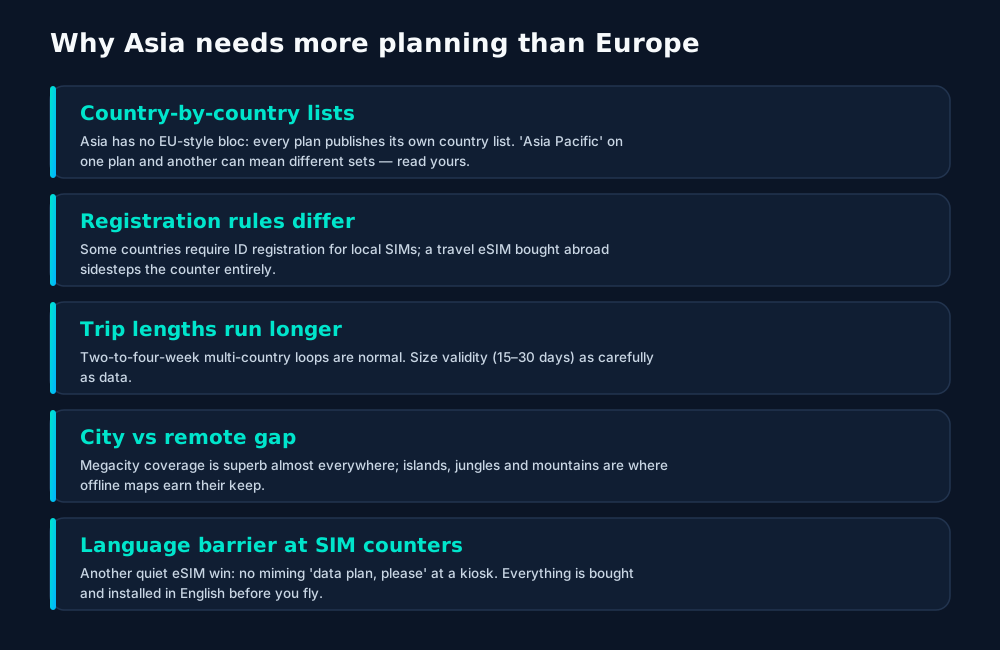
Set expectations correctly and Asia is easy. Set them from a Europe trip and you'll be surprised:
Your connectivity options
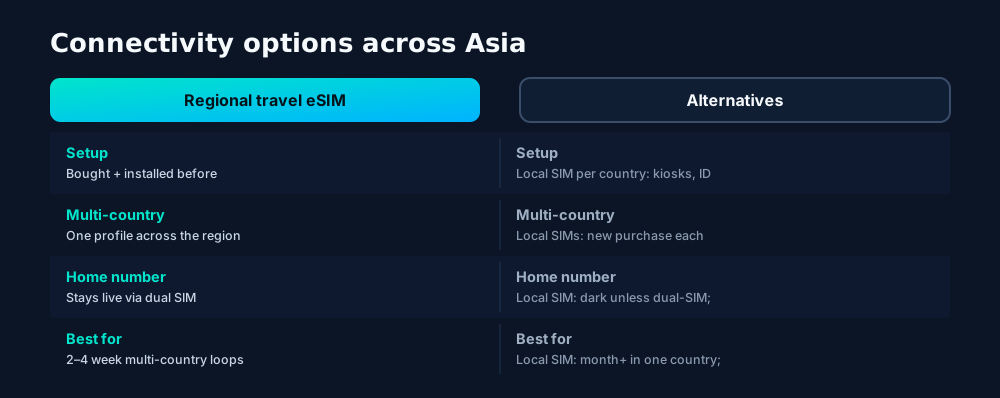
For the classic two-to-four-week loop, the regional travel eSIM is usually the right call. Here's how it stacks against the alternatives:
The setup timeline
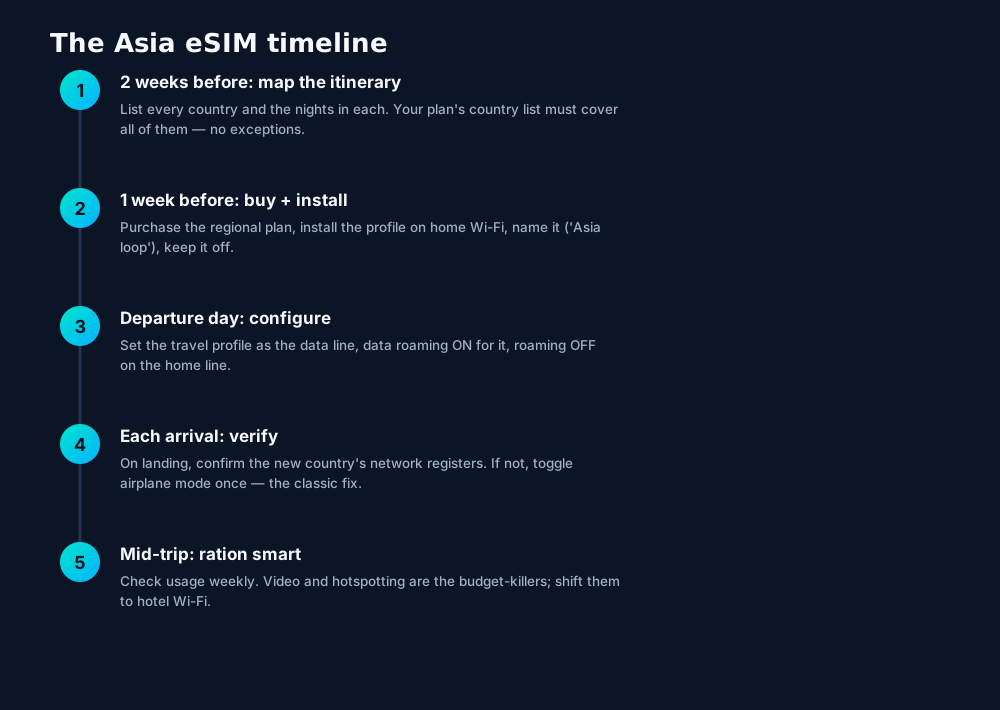
Size validity like data. Travelers obsess over gigabytes and forget the calendar: a 10 GB plan with 15-day validity is useless on day 16 of a 21-day trip. When in doubt between two plans, the longer validity window is usually the better pick.
Field tips
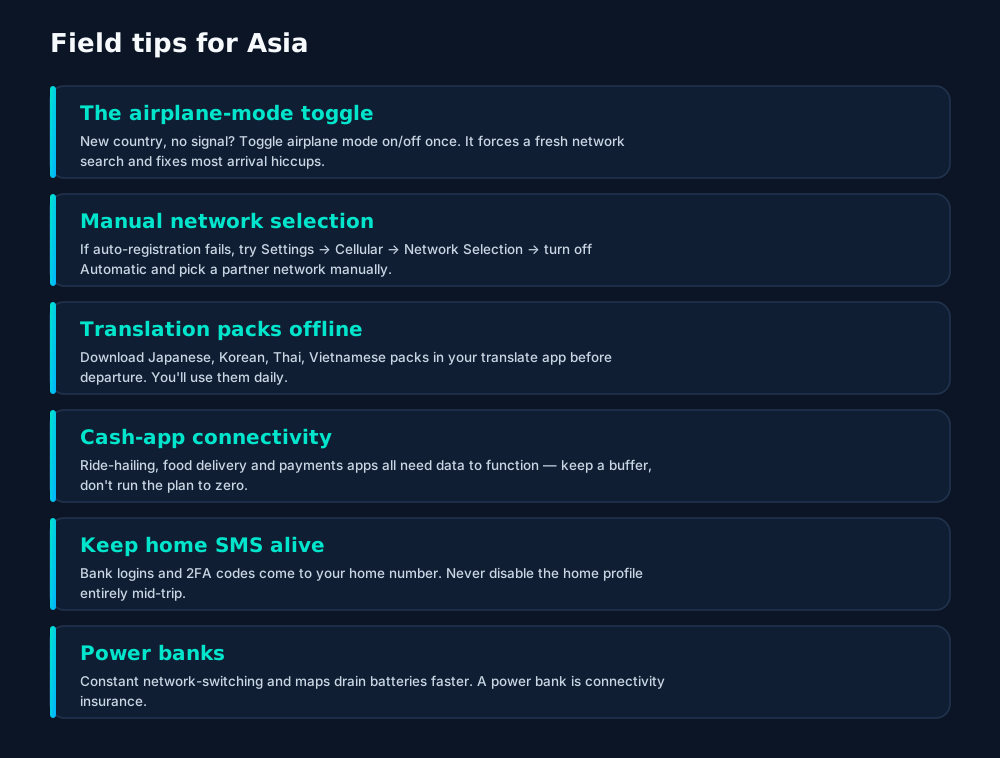
Done right, Asia on an eSIM feels like a superpower: you step off the plane already online, your maps, translators and ride apps just work, and your home number keeps receiving the codes that matter. The SIM-counter queue becomes someone else's problem — preferably while you're already in the taxi.
Frequently asked questions
Does one Asia eSIM work in every Asian country?
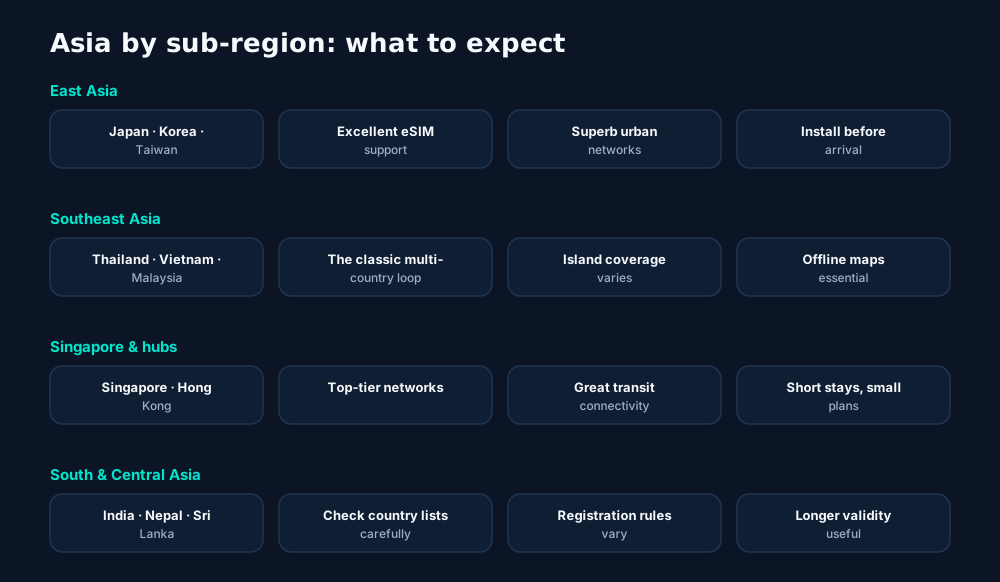
Regional Asia plans typically cover many popular destinations (Japan, Korea, Thailand, Singapore, Malaysia, Vietnam and others) on one profile, but country lists vary by plan — always check yours covers your exact itinerary, especially for South Asia or Central Asia.
Is eSIM widely accepted in Japan?
Yes — Japan's networks fully support eSIM, and it's the standard recommendation for visitors since tourist SIM registration can be fiddly. Install before departure and you're online at Narita/Haneda on arrival.
How long should my Asia eSIM validity be?
Match the trip plus a buffer: Asia trips often run 2–4 weeks across several countries, so 15–30 day validity is the sweet spot. Remember the clock usually starts at activation, not purchase.
Can I top up a travel eSIM mid-trip in Asia?
It depends on the provider — many travel eSIMs are single-use bundles you replace rather than top up. If you might need more, buy a slightly larger allowance up front; it's calmer than hunting for top-ups on hotel Wi-Fi.
Will my eSIM work on every Asian network?
Your profile connects through the plan provider's partner networks in each country. Coverage is generally excellent in cities; remote islands, mountains and rural areas vary — download offline maps regardless.
Keep learning
Hand-picked next reads from the esimgomobile blog — and the product pages they point to.
Inside the app
See the ideas in action.
Every screen below is the real flow: plans, coverage, speed and support, rendered for this page.

- 1The roaming math, made visible: one price versus per-day carrier fees.
- 2This is the comparison most travelers never see until the bill.
- 1The dashboard keeps every eSIM, every trip, in one place.
- 2Rows show data left, days left and current city at a glance.
- 1Mockups illustrate the product flow — captions describe what's real.
- 2Figures labeled as examples show sample data, never live telemetry.
- 1A real traveler quote, tied to the destination it mentions.
- 2Reviews reference actual trips, not generic praise.
- 1Usage ring compresses the whole plan into one glanceable number.
- 2Percent remaining is the only metric most travelers check.
- 1The plan chip: name, allowance and destination in one line.
- 2Everything you need to confirm you're on the right plan.
- 1A real support transcript: the question, then the specific answer.
- 2This is what 'AI support' actually looks like in practice.
- 1The Tele Agent answers in plain language — no telecom jargon.
- 2Every answer is specific to your trip, not a generic FAQ.
- 1Illustrative speed readout: sample carrier, city and latency figures.
- 2The meter demonstrates the readout — figures are examples, not live measurements.
- 1The plan chip: name, allowance and destination in one line.
- 2Everything you need to confirm you're on the right plan.

- 1Mockups illustrate the product flow — captions describe what's real.
- 2Figures labeled as examples show sample data, never live telemetry.
- 1Signal widget: network generation and destination, always visible.
- 2Five bars, zero ambiguity about what you're connected to.
- 1The roaming math, made visible: one price versus per-day carrier fees.
- 2This is the comparison most travelers never see until the bill.
- 1Three plans side by side so the trade-off is obvious.
- 2Pick by trip length, not by decoding fine print.
- 1A real traveler quote, tied to the destination it mentions.
- 2Reviews reference actual trips, not generic praise.
- 1Mockups illustrate the product flow — captions describe what's real.
- 2Figures labeled as examples show sample data, never live telemetry.
- 1The Tele Agent answers in plain language — no telecom jargon.
- 2Every answer is specific to your trip, not a generic FAQ.
- 1A real traveler quote, tied to the destination it mentions.
- 2Reviews reference actual trips, not generic praise.

- 1The dashboard keeps every eSIM, every trip, in one place.
- 2Rows show data left, days left and current city at a glance.
- 1The dashboard keeps every eSIM, every trip, in one place.
- 2Rows show data left, days left and current city at a glance.




















Explainer
Key takeaways
- Setup beats improvisation — every tip in this article works best arranged before departure.
- Match the plan to the trip length and your heaviest single use-case, then stop thinking about it.
- The core idea: Asia eSIM Guide: Japan, SE Asia & More (2026) matters because connectivity shapes the whole trip, not just the phone bill.
- When something goes wrong abroad, the fix is almost always: toggle airplane mode, check the eSIM line is enabled, then ask the Tele Agent.
- Data-first eSIMs keep your number and your apps; the only thing that changes is the price.
Explainer
Putting it into practice
Install the eSIM now — it costs nothing to have it sitting on your phone waiting. Activation happens when you say so.
Then run through the travel tips checklist above. Ten minutes of preparation saves hours of airport problem-solving.
Reading about Asia eSIM Guide: Japan, SE Asia & More (2026) is step zero. Step one is a two-minute action: check your phone is unlocked and eSIM-capable, then pick a plan sized to your next trip.
Go deeper
The tools index turns article advice into instant answers — coverage checks, plan pickers and compatibility checks that take seconds.
And the Tele Agent will walk through any of this conversationally if you'd rather talk than read.
Explainer
Common mistakes to avoid
- Forgetting two-factor: banks text your home number — keep that SIM active.
- Disabling the wrong line: label your eSIM clearly in phone settings.
- Ignoring the 80% alert: top up early; data never gets cheaper mid-trip.
- Buying data at the airport: the most expensive megabyte is the panicked one.
- Assuming hotel Wi-Fi will do: it won't, at the exact moment you need it most.
See the math
Asia eSIM Guide: Japan, SE Asia & More (, visualized.
Asia eSIM Guide: Japan, SE Asia & More (2026 — data dashboard
The numbers behind the story, switchable by dataset.
Hover any bar or point for its exact value. Tabs switch datasets — everything on this panel is computed from live product data unless labeled illustrative.
Your plan is two minutes away
Join thousands of travelers who land connected. Your eSIM installs in two minutes.