Blog · Travel guides
Europe on one eSIM: the complete travel guide.
Thirty countries, open borders, one eSIM: how to stay connected across Europe with a single multi-country profile — EU roaming rules, dual-SIM strategy, setup timing and data planning.
Why Europe is the perfect eSIM continent
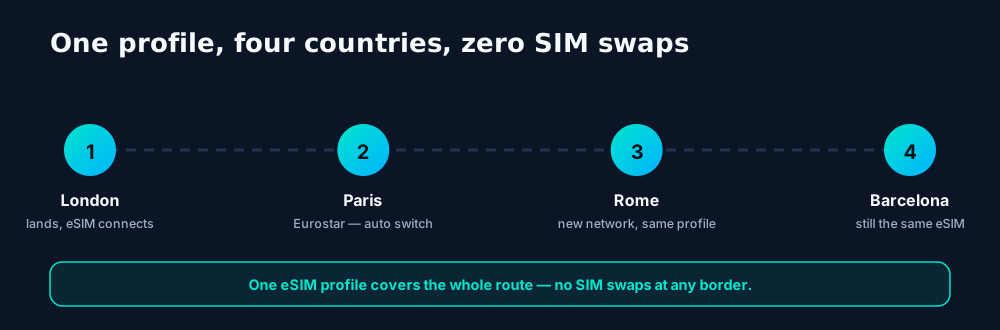
Europe is the continent the travel eSIM was invented for: thirty-odd countries, open borders, and itineraries that cross three of them before lunch. The old way — a new SIM card in every country, or home-carrier roaming at painful per-megabyte rates — made connectivity the most annoying part of the trip. The new way is one profile, installed before you leave, that quietly switches networks at every border.
EU roaming rules, for visitors
Europe's roaming story has two chapters, and knowing which one you're in saves real money:
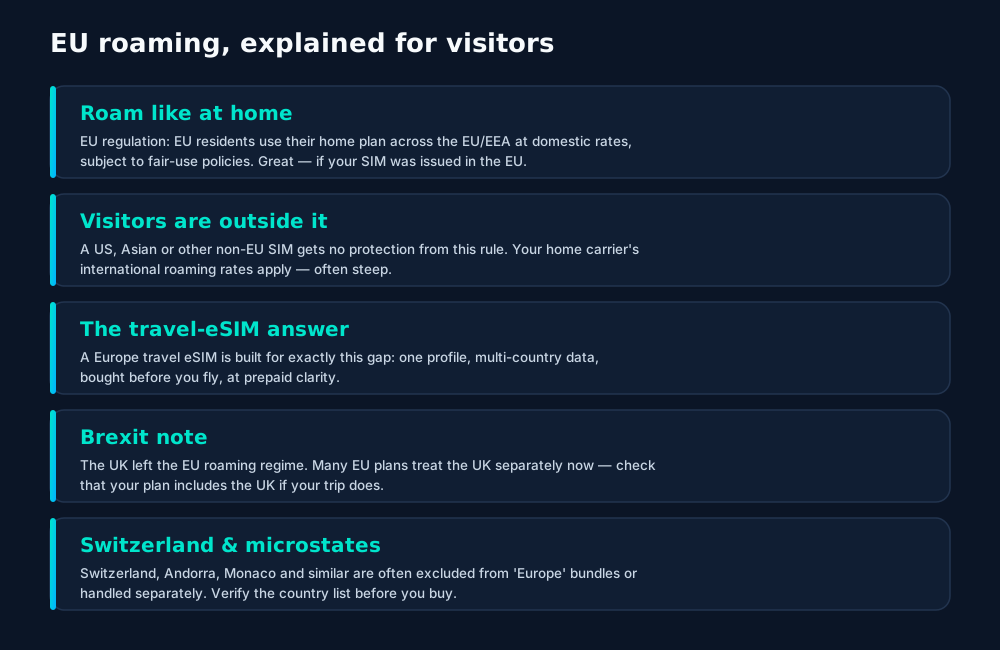
If you're visiting from outside the EU, the practical takeaway is simple: don't rely on your home plan's default roaming unless you've checked the rates and they're genuinely fine. The travel-eSIM alternative is a prepaid, multi-country profile with a known data allowance and a known expiry — no bill shock, ever.
The setup timeline
Timing is half the battle. A Europe eSIM installed calmly at home beats one installed frantically at the airport:
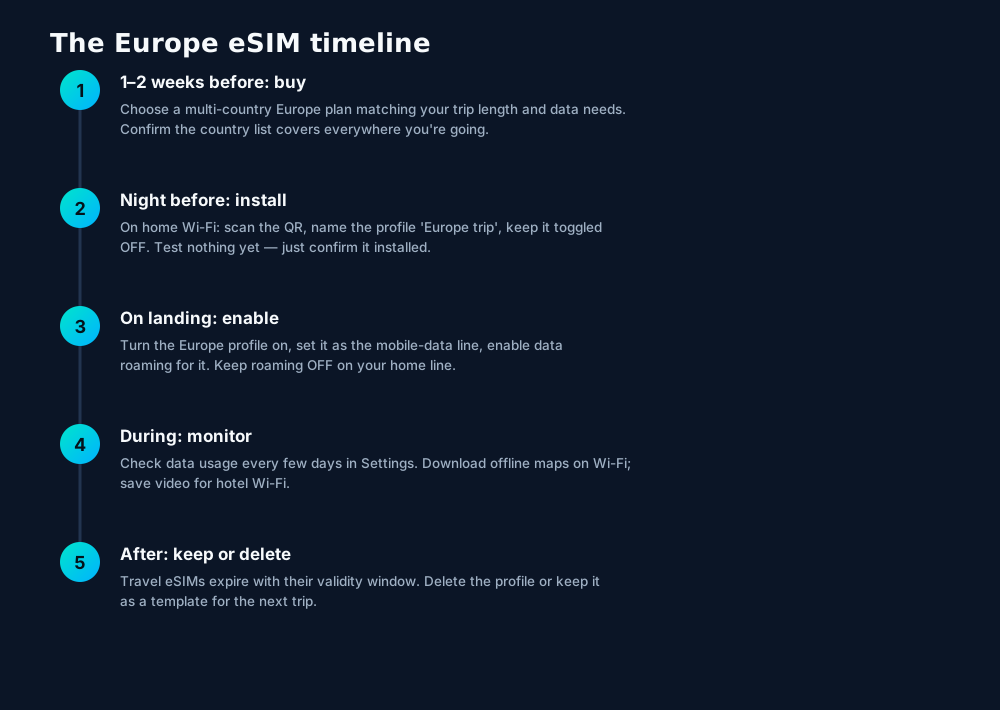
The golden rule of travel eSIMs: install early, activate late. Installing only downloads the profile; the validity clock starts when you first enable it (or on first network registration, depending on the carrier). Install the night before, enable on landing.
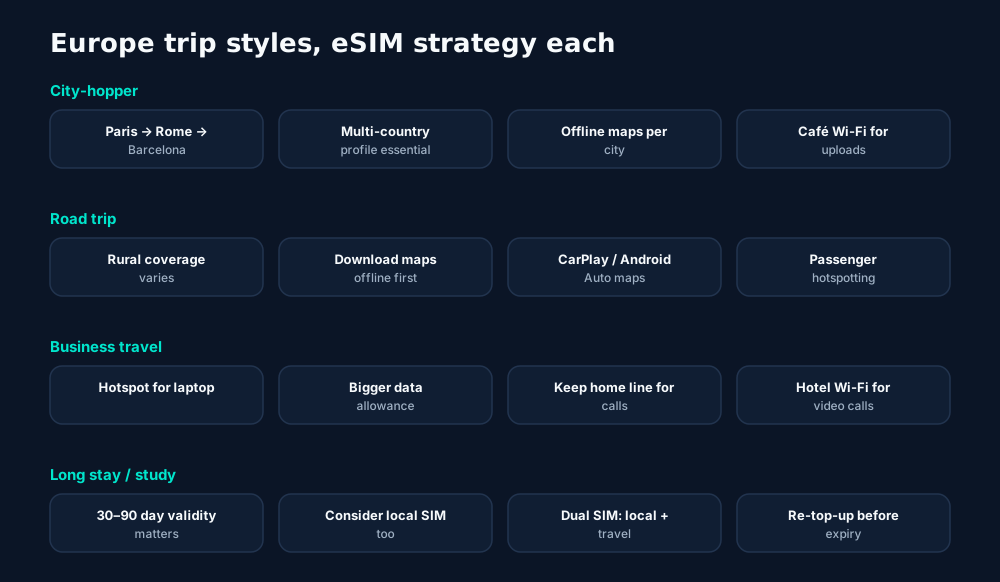
Strategy by trip style
Europe isn't one trip — it's four or five, and the eSIM strategy shifts with each:
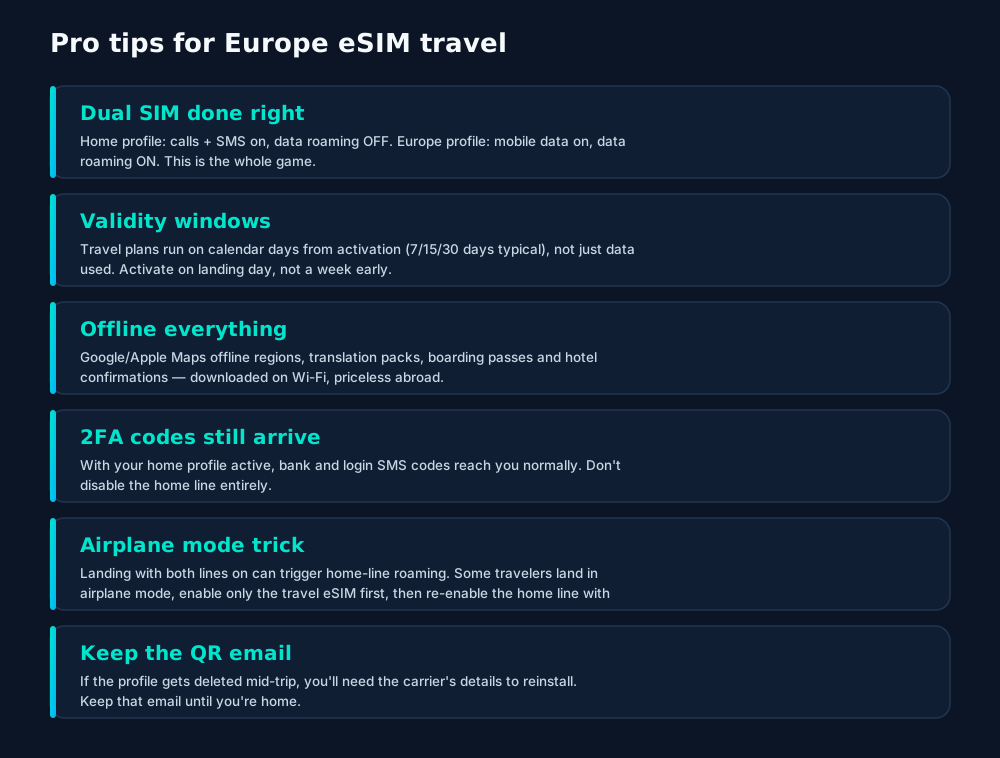
Pro tips
A few field-tested habits separate smooth trips from expensive ones:
And when the trip's over, do a two-minute cleanup: check the final bill (there shouldn't be surprises on prepaid), delete or archive the expired profile, and note what data you actually used — it's the best input for sizing your next trip's plan. Which brings us to the eternal question:
How much data? Our companion guide How Much Data Do You Need When Traveling? turns your habits into a concrete allowance.
Frequently asked questions
Do I need a different eSIM for each European country?
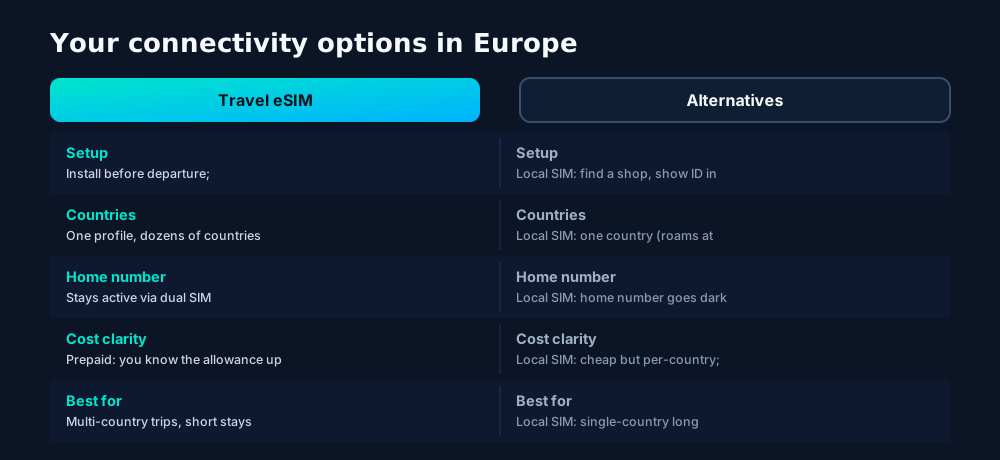
No — that's the point. Travel eSIM plans sold for Europe are multi-country by design: one profile connects in dozens of countries, switching networks automatically as you cross borders.
What is 'Roam like at home' in the EU?
An EU regulation letting EU residents use their domestic plan across the EU/EEA at domestic prices, within fair-use limits. It applies to EU-issued SIMs — visitors from outside the EU need a travel eSIM or local SIM instead.
Should I install my Europe eSIM before I leave?
Yes. Install on home Wi-Fi the night before departure, keep it toggled off, and enable it on landing. You arrive connected instead of hunting for Wi-Fi or SIM shops.
Will my home number still work in Europe?
Yes, with dual SIM: keep your home profile active for calls and SMS (including 2FA codes) and route mobile data through the Europe eSIM. Just keep data roaming off on the home line.
How much data do I need for two weeks in Europe?
It depends on habits, not geography: light users (maps, messaging, browsing) often manage on a few GB; heavy users (video, hotspotting) need much more. Our data calculator guide breaks it down by traveler type.
Keep learning
Hand-picked next reads from the esimgomobile blog — and the product pages they point to.
Product tour
Key moments, as product screens.
Twenty product screens and twenty field photos — this is what traveling connected looks like.
- 1The plan chip: name, allowance and destination in one line.
- 2Everything you need to confirm you're on the right plan.
- 1Coverage status at a glance: data live, number available, 5G ready.
- 2Green means go — no guessing about what's supported.
- 1Coverage pins show where partner networks are live.
- 2The map answers the only question that matters: will it work there?
- 1Illustrative speed readout: sample carrier, city and latency figures.
- 2The meter demonstrates the readout — figures are examples, not live measurements.

- 1A real support transcript: the question, then the specific answer.
- 2This is what 'AI support' actually looks like in practice.
- 1Three plans side by side so the trade-off is obvious.
- 2Pick by trip length, not by decoding fine print.
- 1The plan chip: name, allowance and destination in one line.
- 2Everything you need to confirm you're on the right plan.
- 1Three plans side by side so the trade-off is obvious.
- 2Pick by trip length, not by decoding fine print.
- Hotspot included
- 24/7 support
- Instant QR install
- 1A real traveler quote, tied to the destination it mentions.
- 2Reviews reference actual trips, not generic praise.

- 1A real traveler quote, tied to the destination it mentions.
- 2Reviews reference actual trips, not generic praise.
- 1The Tele Agent answers in plain language — no telecom jargon.
- 2Every answer is specific to your trip, not a generic FAQ.
- 1Three plans side by side so the trade-off is obvious.
- 2Pick by trip length, not by decoding fine print.

- 1A real traveler quote, tied to the destination it mentions.
- 2Reviews reference actual trips, not generic praise.
- 1Live usage ring: see remaining data at a glance, no mental math.
- 2Top-up button sits right where you need it when data runs low.
- 1Illustrative speed readout: sample carrier, city and latency figures.
- 2The meter demonstrates the readout — figures are examples, not live measurements.
- 1A real support transcript: the question, then the specific answer.
- 2This is what 'AI support' actually looks like in practice.
- 1A real support transcript: the question, then the specific answer.
- 2This is what 'AI support' actually looks like in practice.
- 1A real traveler quote, tied to the destination it mentions.
- 2Reviews reference actual trips, not generic praise.
- 1The Tele Agent answers in plain language — no telecom jargon.
- 2Every answer is specific to your trip, not a generic FAQ.
- 1Signal widget: network generation and destination, always visible.
- 2Five bars, zero ambiguity about what you're connected to.



















Explainer
Key takeaways
- When something goes wrong abroad, the fix is almost always: toggle airplane mode, check the eSIM line is enabled, then ask the Tele Agent.
- Data-first eSIMs keep your number and your apps; the only thing that changes is the price.
- Match the plan to the trip length and your heaviest single use-case, then stop thinking about it.
- The core idea: Europe eSIM Guide: One Plan, 30+ Countries matters because connectivity shapes the whole trip, not just the phone bill.
- Setup beats improvisation — every tip in this article works best arranged before departure.
Explainer
Putting it into practice
Install the eSIM now — it costs nothing to have it sitting on your phone waiting. Activation happens when you say so.
Reading about Europe eSIM Guide: One Plan, 30+ Countries is step zero. Step one is a two-minute action: check your phone is unlocked and eSIM-capable, then pick a plan sized to your next trip.
Then run through the travel tips checklist above. Ten minutes of preparation saves hours of airport problem-solving.
Go deeper
And the Tele Agent will walk through any of this conversationally if you'd rather talk than read.
The tools index turns article advice into instant answers — coverage checks, plan pickers and compatibility checks that take seconds.
Explainer
Common mistakes to avoid
- Ignoring the 80% alert: top up early; data never gets cheaper mid-trip.
- Disabling the wrong line: label your eSIM clearly in phone settings.
- Buying data at the airport: the most expensive megabyte is the panicked one.
- Forgetting two-factor: banks text your home number — keep that SIM active.
- Assuming hotel Wi-Fi will do: it won't, at the exact moment you need it most.
Charts & explainers
Europe eSIM Guide: One Plan, 30+ Countri, visualized.
Europe eSIM Guide: One Plan, 30+ Countries — data dashboard
The numbers behind the story, switchable by dataset.
Hover any bar or point for its exact value. Tabs switch datasets — everything on this panel is computed from live product data unless labeled illustrative.
Take us with you, connected
Pick a plan, check out securely, scan the QR code — you're online before you land.