What a “SIM number” really is.
When people say “my real number,” they usually mean the number tied to their SIM card. That number’s identity is bound to a physical chip (or these days, an eSIM profile) inside one specific phone. The mobile network knows which tower you’re on, routes your calls over the radio network, and everything — voice, SMS, data billing — flows through your carrier’s core.
This model is forty years old and it works beautifully for one job: being reachable as a person, on a phone, wherever the carrier has coverage. The number, the device and the network subscription are one bundled thing. That bundling is both its strength and its limitation.
A virtual number unbundles it. The number becomes pure identity — software in the cloud — while connectivity becomes whatever internet you have handy. Same digits your callers dial; completely different machinery underneath.
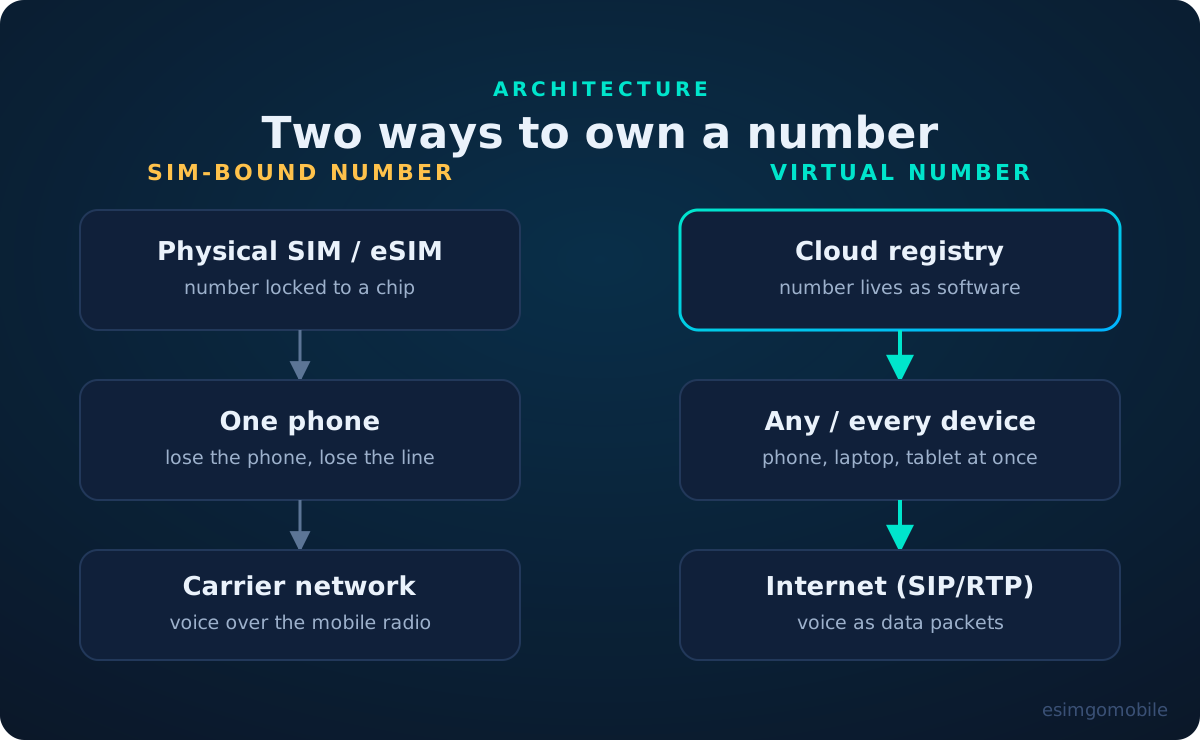
Two architectures, side by side.
With a SIM number, the chain is: chip → phone → carrier radio network. Lose the phone and you’ve lost the line until the carrier reissues the SIM. Want the number on two devices at once? You basically can’t — the network registers the number to one device at a time.
With a virtual number, the chain is: cloud registry → internet → any signed-in device. The number exists as a record in a provider’s system, and SIP signaling tells your devices when someone’s calling. Add a laptop, a tablet, a desk phone — they all ring.
Head-to-head.
Feature by feature, no marketing gloss:
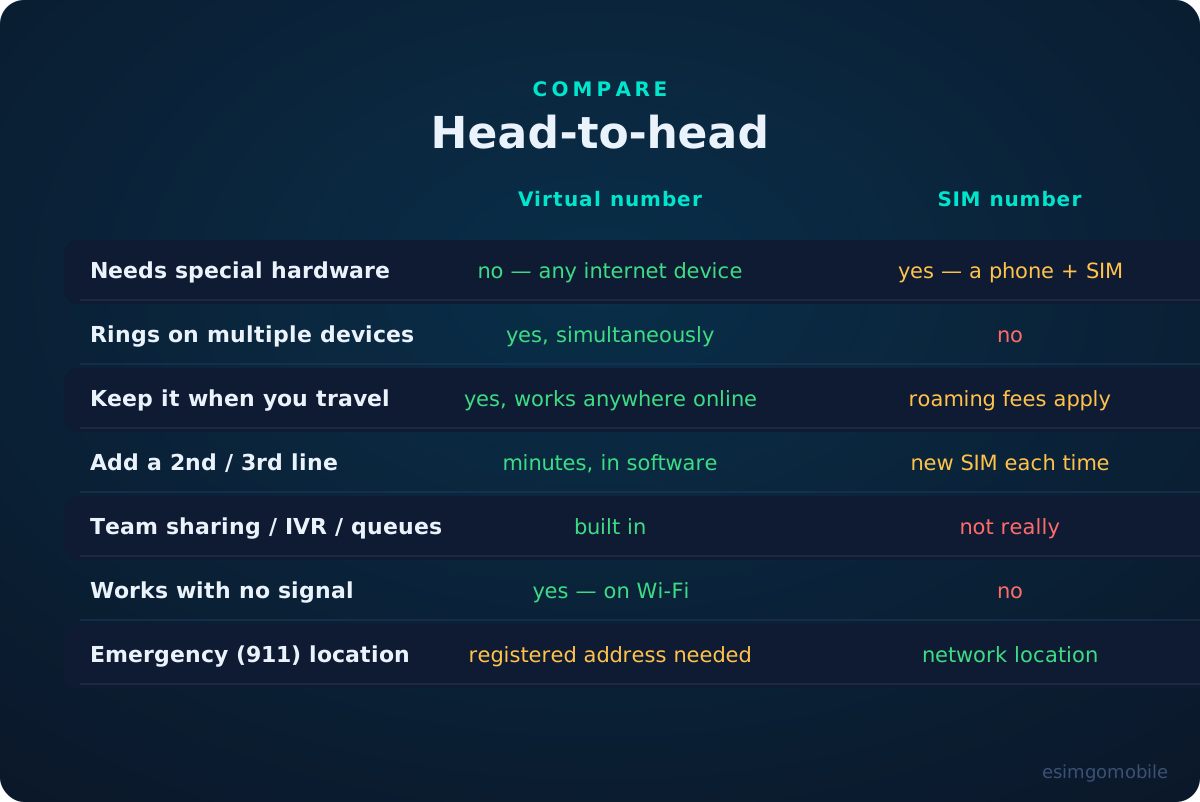
A few of these deserve unpacking. Multi-device ringing is the virtual number’s killer feature: one number rings your phone, laptop and tablet simultaneously, and whoever picks up — wherever they are — gets the call. A SIM number can forward, but it can’t truly ring everywhere at once.
Emergency location is the SIM’s honest advantage. A mobile network knows your approximate location from the towers; a virtual number only knows the address you registered. That’s why E911 registration exists — and why you should never rely on a virtual-only line as your sole emergency phone without setting it up properly.
The hybrid setup most professionals land on.
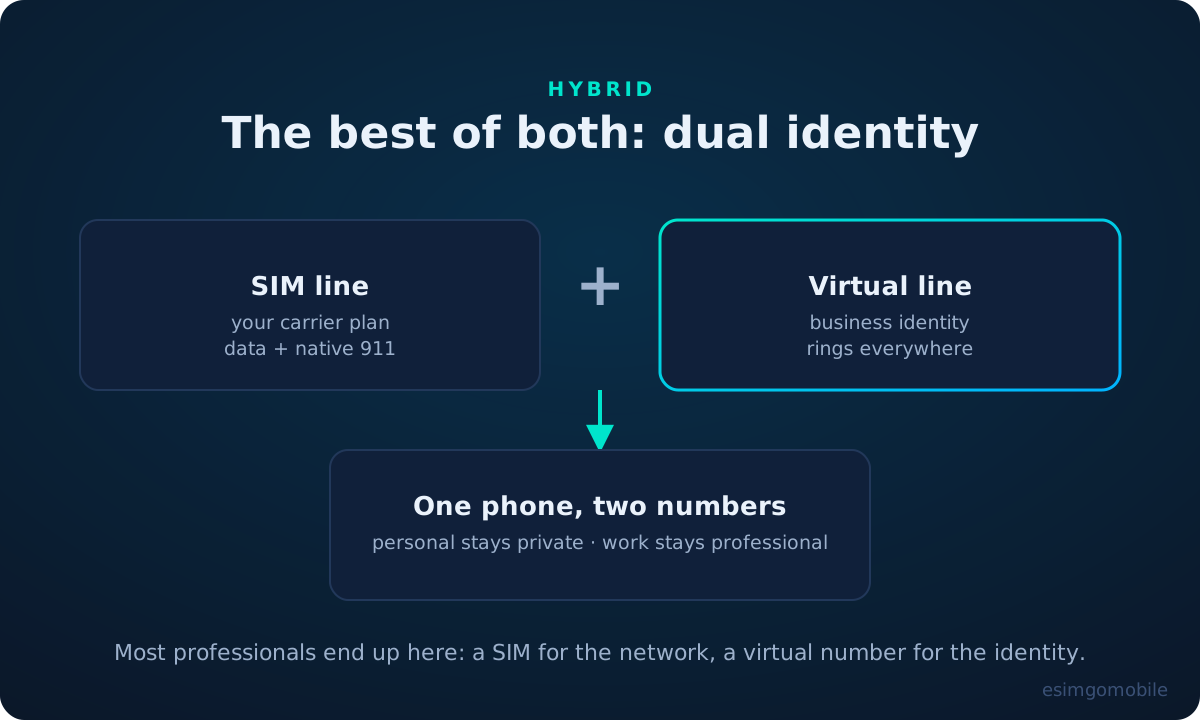
Here’s the open secret: this isn’t really an either/or choice. The setup that experienced remote workers, founders and travelers converge on is both:
- A SIM line (physical SIM or eSIM) for the carrier plan: mobile data, native emergency calling, the number your bank and your mother have.
- A virtual line for the public identity: the business number on the website, the line clients call, the one with business hours, routing and a professional voicemail.
One phone, two numbers, two ringtones’ worth of context. Personal stays private; work stays professional; and when you travel, the virtual line follows you onto hotel Wi-Fi while the SIM line naps in airplane mode.
What about reliability?
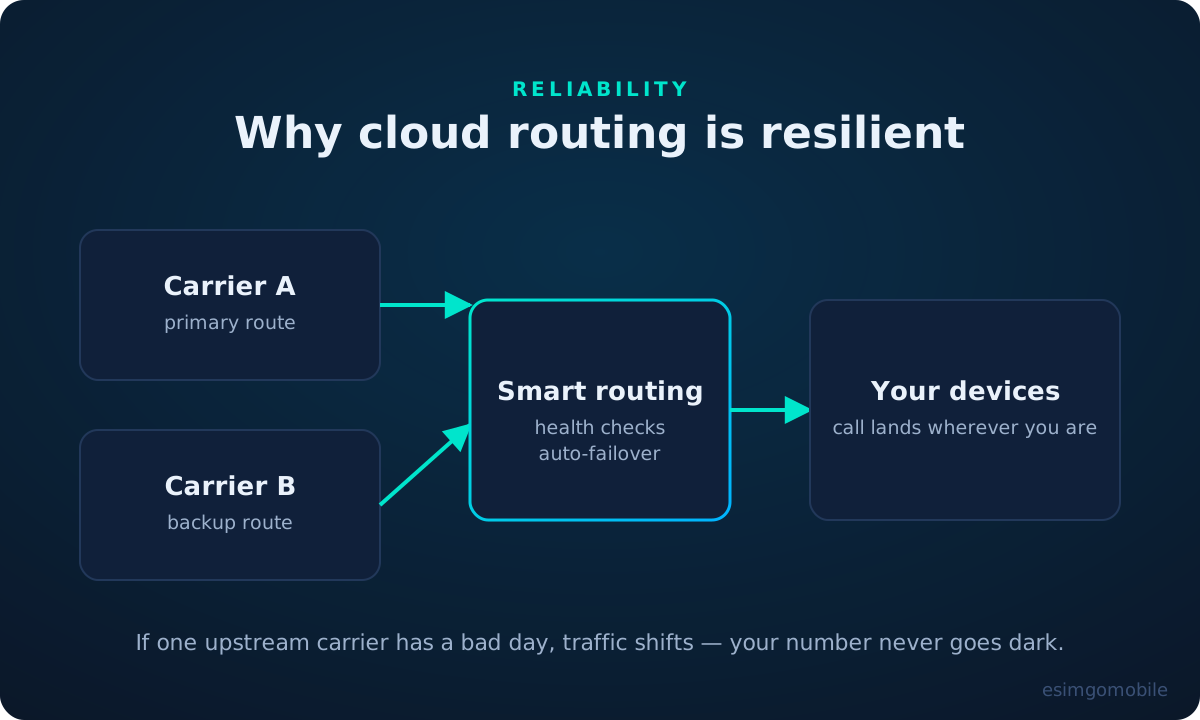
“But what if the internet goes down?” Fair question — and the answer surprises people. A serious virtual-number platform doesn’t have one path to you; it has several. Calls arrive via redundant carrier interconnects, the platform health-checks its routes, and if one upstream carrier has a bad day, traffic shifts automatically. Your devices are just the last hop.
Compare that to a single SIM on a single carrier: one network, one point of failure. Cloud telephony’s redundancy is architectural, not accidental — it’s the same reason websites don’t live on one server anymore.
The genuine dependency is your last-mile internet. On Wi-Fi or 5G that’s rarely the binding constraint — a voice call needs roughly 100 kbps, a rounding error on modern connections. And when you truly are offline, the cloud still answers: voicemail, auto-attendant and forwarding rules run server-side, with or without you.
The cost model, unbundled.
A SIM plan bundles everything — the number, the network, the device subsidy, the support — into one monthly bill. A virtual number unbundles it: you pay a small rental for the number itself, plus metered usage for the minutes and messages you actually consume. No hardware, no store visit, no 24-month contract to add a second line.
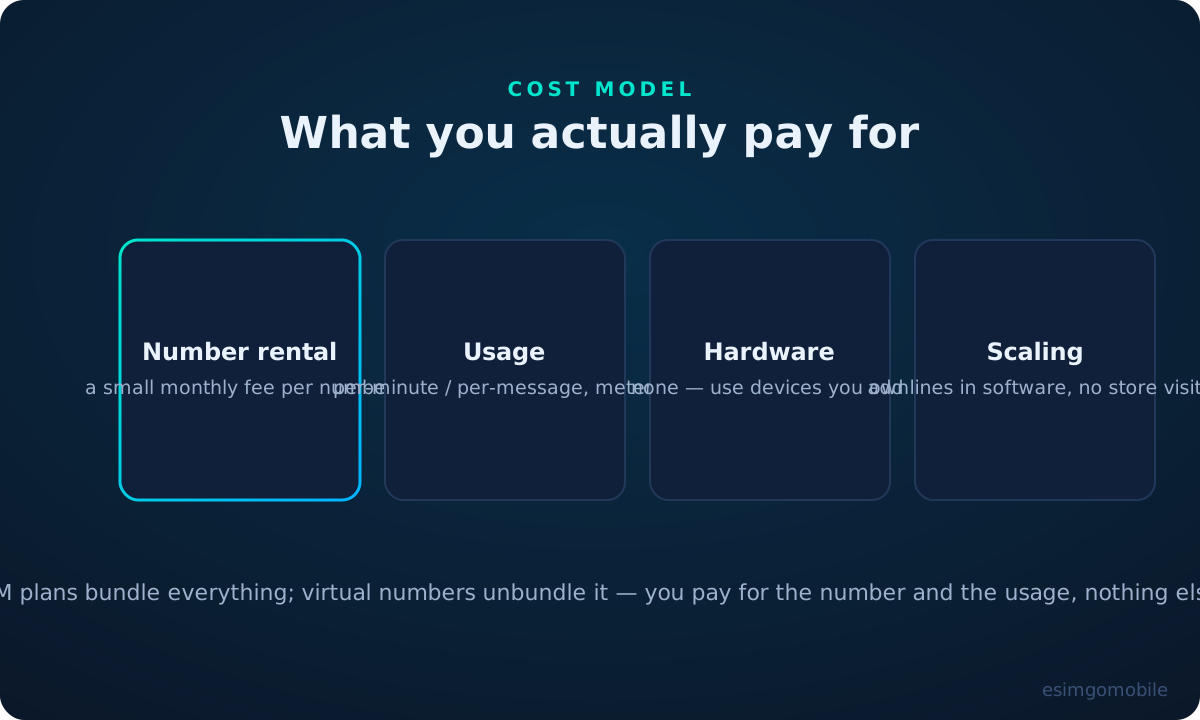
Which is cheaper depends entirely on the shape of your usage. One person with one line? A SIM plan is simple and often cheaper. A team sharing numbers, a business with lines in six cities, anyone who needs numbers programmatically? The virtual model wins by a mile — because the marginal cost of line number two is close to zero.
Which should you pick?
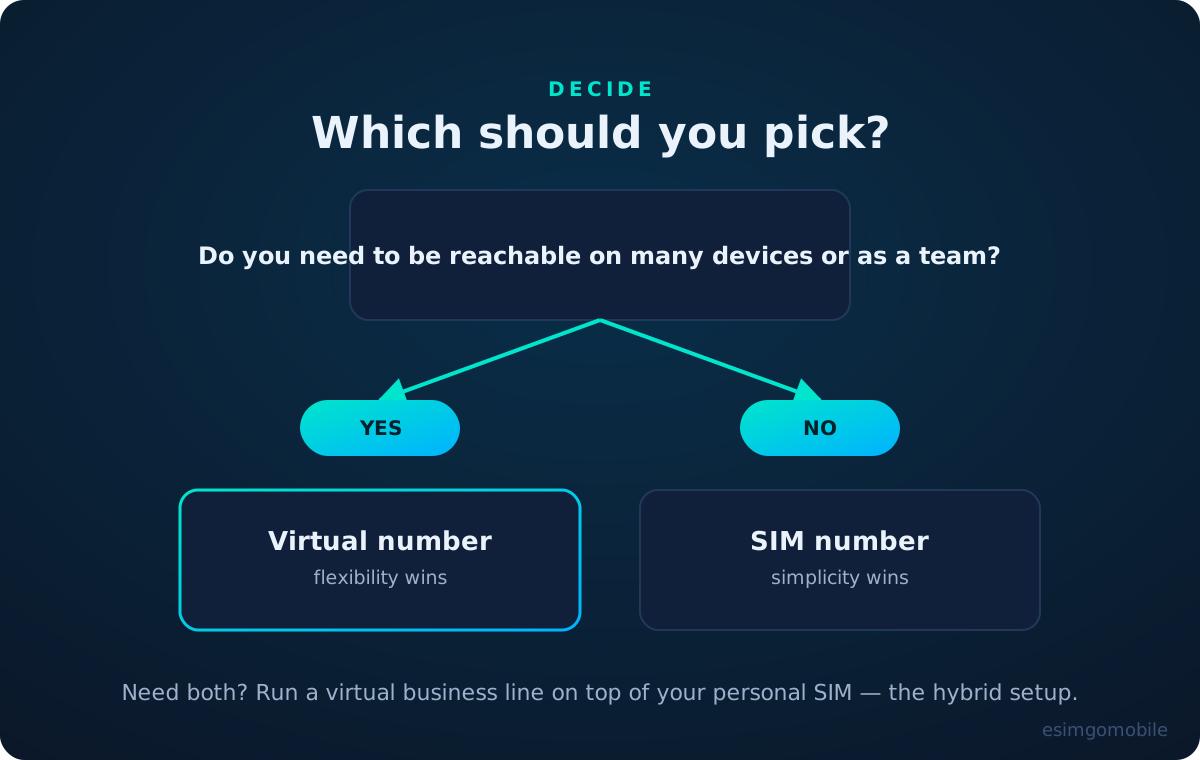
Ask one question: does the number need to be reachable on many devices, or shared by a team, or managed like software? If yes — virtual. If you just need one person reachable on one phone with minimal fuss — SIM. And if you want both, run the hybrid: it’s the most common setup among people who’ve thought about this for more than a week.
esimgomobile’s take: we’re building both halves of the hybrid — real eSIM plans with real numbers, plus cloud virtual numbers for any device. One account, one bill — live now. Get started.
Questions, answered.
Can I have a virtual number and a SIM number on the same phone?
Is call quality worse on a virtual number?
Can I port my SIM number to a virtual provider?
What happens to my virtual number if I lose my phone?
Do virtual numbers work for 2FA codes?
Where to go next.
Get your virtual number today.
Virtual numbers are live now — claim yours alongside any eSIM plan.